Double Cleansing: Who Actually Needs It, and Who's Just Washing Twice for Nothing
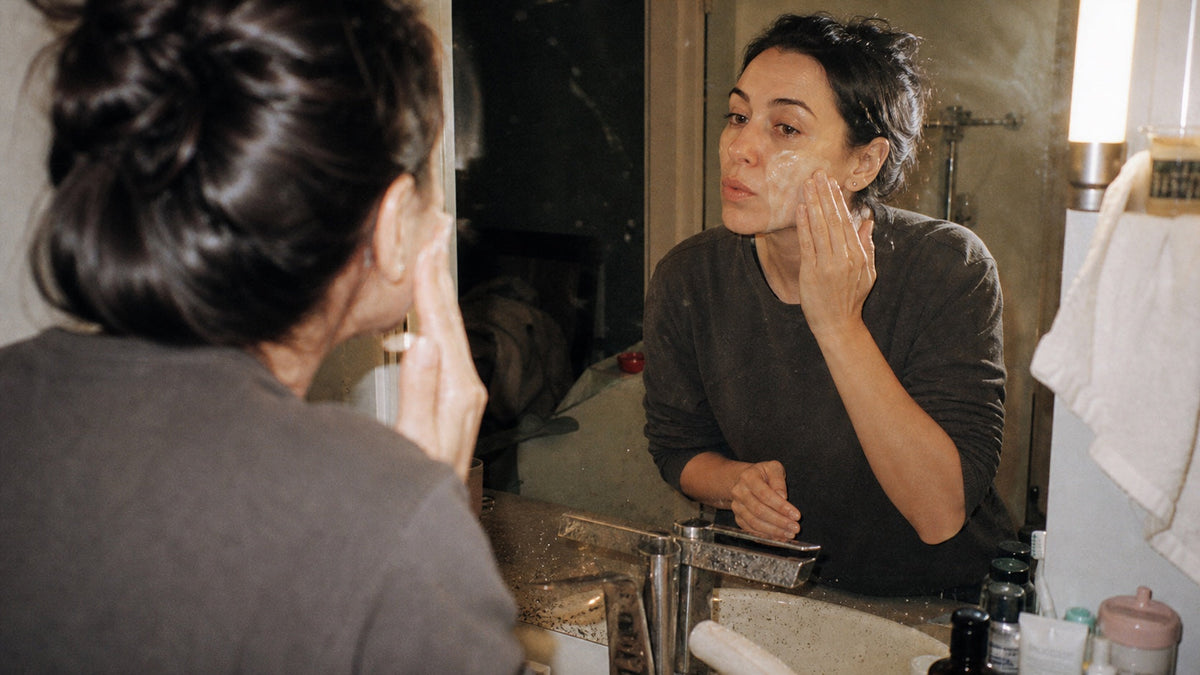
The bottle said morning and night. The tube standing next to it said the same thing. That comes to four cleanses a day on a face that had worn nothing but moisturizer since Thursday.
We opened this one expecting to write that double cleansing strips your barrier lipids. It's the sentence everybody writes, us included, in older drafts we never published. Six papers in we couldn't write it. When researchers actually went looking for the missing lipids, the lipids were still there.
So it turned into a different piece.
If you wear water-resistant sunscreen or long-wear makeup, the oil step isn't a ritual, it's load-bearing: in a 2020 trial, plain water left 59.3% of a waterproof sunscreen on the face and a foaming cleanser still left 36.8%, while cleansing oil got down to 5.8% against a 3.2% baseline. If you're bare-faced, the second step has nothing left to dissolve, and you're paying for it. The cost just isn't the one you've been sold. Your barrier lipids are not being rinsed down the drain. What actually shifts is skin surface pH and the protein structure of the stratum corneum, and how much that costs you depends far more on which cleanser you pick than on how many times you use one.
Start with the thing water cannot do
Chen and colleagues at Sichuan University put twenty people through a straightforward test in 2020. Apply sunscreen, remove it three ways, then photograph the face under VISIA imaging and quantify what stayed on. They ran it twice, once with a normal sunscreen and once with a water-resistant one.

| Removal method | Regular sunscreen left on skin | Waterproof sunscreen left on skin |
|---|---|---|
| Nothing (baseline reading) | 9.9% ± 4.8 | 3.2% ± 2.2 |
| Water only | 54.0% ± 19.2 | 59.3% ± 10.4 |
| Foaming cleanser | 15.6% ± 6.1 | 36.8% ± 8.8 |
| Cleansing oil | 13.4% ± 4.6 | 5.8% ± 3.3 |
Read the right-hand column twice. A foaming cleanser, used properly, walked away from more than a third of a waterproof sunscreen. Only the oil brought it back down to something near the baseline reading. And that isn't a knock on the foam so much as a description of what water resistance is. The FDA only lets a product claim it after testing that the film survives 40 or 80 minutes of swimming or sweating. A film engineered to shrug off water and sweat will also shrug off a water-based wash. That's the whole point of it.
There's a small detail in that paper worth keeping. Eight people in the cleanser group reported dry skin afterwards. One did in the oil group.
The stripping story, tested
Here is where the received wisdom falls over.

Froebe and Kligman went looking for surfactant-stripped lipids in 1990 and found that sodium lauryl sulphate and linear alkyl benzene sulfonate only pull measurable lipid out of the stratum corneum above their critical micelle concentration, and even then they take "very small amounts" of cholesterol, free fatty acids and squalene. The awkward part is that both surfactants bind to skin and irritate it well below that concentration. Irritation was happening in a range where no lipid was leaving. Their conclusion was blunt: clinical irritation "is unlikely to be directly linked with extraction of SC lipid."
Fulmer and Kramer had already run the harder version of the experiment four years earlier. Ten people, 4% SDS on one lower leg once a day for two weeks, the other leg as control, then shave biopsies to weigh what was left. The treated skin got drier and scalier, exactly as expected. Total lipid per gram of stratum corneum protein: unchanged. What had changed was the composition. The free cholesterol to cholesterol ester ratio climbed while total sterols held steady, the ceramide species redistributed while total ceramides held steady, and one of the two free fatty acid bands faded.
Which is a more interesting finding than the myth it replaces. Surfactants aren't dissolving your barrier and washing it away. They're disturbing the machinery that builds it, and the skin then makes the wrong lipids in roughly the right quantity. Fulmer's treated legs carried the same weight of lipid as the untreated ones. It was the wrong lipid.
We wanted a clean answer on micellar water and never got one. There is no controlled trial isolating the no-rinse micellar format against a rinse-off cleanser on any barrier endpoint we could find. The one study that keeps getting cited tests micellar water bundled with a cream and a serum, in rosacea patients, with ten controls and two authors employed by the manufacturer. That tells you about the three-product regimen. It tells you nothing about the bottle.
What the second step actually costs
pH, mostly.

Blaak and Staib's 2018 review makes a point that gets skipped in every routine video: skin surface pH climbs after a single wash, and it climbs "after rinsing the skin with water alone" too. Recovery to physiological level takes up to several hours. Not minutes. Their recommendation for a cleansing product is pH 4.0 to 5.0.
Baranda's group had already put a number on why that matters. They took 17 products marketed for dry skin plus 12 ordinary soaps, applied them under aluminium chambers to the forearms of 30 sensitive-skin volunteers for five straight days, and scored erythema, scaling and fissuring. Product pH correlated with the irritation score at P < 0.006. The gentlest products were overwhelmingly synthetic detergents rather than true soaps.
And the damage accumulates in a way single-wash studies miss. Tupker's team applied eleven surfactants at 12.5 mmol/L for 45 minutes twice daily for three weeks and watched transepidermal water loss climb steadily for every single one. The ranking of which surfactant was harshest stayed stable across individuals and across all three weeks, which is the useful part: the identity of the surfactant predicted the damage far better than the fact of washing did.
So the honest framing of a second cleanse is not that it removes something precious. It's that it doubles your daily count of pH excursions and surfactant contact, on a schedule where, by Blaak and Staib's reading, recovery runs to several hours, for a payoff that only exists if there was something on your face worth dissolving.
The one randomized trial on washing frequency does not say what we assumed it would. Choi, Lew and Kimball put men with mild-to-moderate acne through six weeks of washing once, twice or four times daily. Four times a day was not worse than twice. Once a day was worse, with significant increases in erythema, papules and total inflammatory lesions. We're citing it against our own instincts, because leaving it out would be dishonest. It also isn't a barrier study, and it used one mild cleanser rather than two steps.
Five formats, and what each is actually for
Oil and balm do the same job through the same chemistry, dissolving the sunscreen film and the wax-and-pigment part of makeup. Balm gives you more control over where it goes and generally comes with fewer drips; oil spreads faster over a whole face. Choose on texture preference, because the mechanism doesn't care. The lead ingredient in the Shingmulnara balm we sell is cetyl ethylhexanoate, an ester oil, and the lead ingredient in most cleansing oils is an ester oil too.
Cleansing water sits in an odd position. It lifts light makeup adequately, it involves no rinse and therefore no second pH excursion, and it has essentially no controlled evidence behind it as a category. We stock a 500ml one, the Little Mermaid cleansing water, and it screened at 9.3. That score is about the ingredient list. It is not a claim that the format has been tested.
Powder cleansers are usually a dry amino-acid surfactant plus a protease such as papain, sold on the promise of gentleness. The gentleness comes from the surfactant, not the format. A protease chews on the corneodesmosome proteins holding dead cells together; it does nothing at all to a sunscreen film, which is why a powder is always a second step and never a first one.
Foam is the second step, and the one place where your choice actually shows up on your skin. A surfactant system built on amino-acid derivatives at weakly acidic pH is a different object from an alkaline soap, and Tupker's ranking is the reason that distinction outranks everything else on this list.
What our screening found
Our own cleansing shelf argues against the routine we sell into. Nine of the cleansing products we carry describe themselves in their own copy as needing a partner step for heavy or waterproof makeup, which is a fair description of what they are and also an admission that the second step is a makeup problem rather than a hygiene one. Our worst flag here is in a product we scored 9.8: the YBK Relief Hydration Light Foam Cleanser is labelled "no added fragrance," and it contains Mentha Arvensis leaf powder, and reviewers describe a mild mint-herbal scent. Both things are true at once. "No added fragrance" is a claim about what the formulator poured in, not about what your nose finds, and we've said elsewhere that this exact phrasing is one of the weaker label claims on the shelf. It stays at 9.8 because all 51 of its screened ingredients came back low-risk and the surfactant system is sodium cocoyl glycinate and sodium lauroyl glutamate at weakly acidic pH, which is the profile the Tupker ranking and the Blaak pH target both point toward. But we're not going to pretend the label is precise.

Shingmulnara Young Green Tea Squeeze Cleansing Balm 100ml
All 33 screened ingredients came back low-risk, fragrance-free and PEG-free, in a squeeze tube rather than a jar. It's a light balm, so waterproof point makeup will still need a dedicated remover, and it stings if it reaches your eyes.

YBK Relief Hydration Light Foam Cleanser 150ml
Sulfate-free amino-acid surfactants at weakly acidic pH, with five ceramides and cholesterol in the formula. Flagged above for the mint powder behind its "no added fragrance" line, and it needs plenty of water to lather.
The practical takeaway
Ask one question at the sink: is there a film on my face that water cannot dissolve? Water-resistant sunscreen, long-wear base, waterproof mascara, a heavy occlusive balm. If yes, the oil or balm step is doing measurable work and skipping it leaves 36.8% of that film sitting there overnight, by Chen's numbers. If no, you are running a second surfactant pass over clean skin.
Bare-faced mornings are the easiest cut. Nothing accumulated on your face while you slept except the products you chose to put there, and most of those come off with the foam alone. Both of the cleansers we recommend below sit at 9.8, and both describe themselves, in their own manufacturer copy, as makeup-removal tools. On a face with no makeup on it, that job doesn't exist.
If your skin feels tight after cleansing, change the cleanser before you change the count. That's where the Tupker ranking and the Baranda pH correlation both point, and it's a cheaper experiment than restructuring your routine. The same logic runs through what we found on layering order: the step you agonise over is rarely the step that moves the number.
One more caveat we can't dress up. The whole cleansing literature is thin. Most of it is forearm patch testing on twenty to thirty people, not faces, not over months, and almost none of it tests two steps against one directly. We looked for that trial. It doesn't exist. Everything above is inference from adjacent evidence, and we'd rather say so than round it up to certainty, which is the same standard we apply to claims printed on the front of the bottle and to every product that clears our screening.
- Chen W, He M, Xie L, Li L, "The optimal cleansing method for the removal of sunscreen: Water, cleanser or cleansing oil?" Journal of Cosmetic Dermatology 19(1):180–184 (2020). link
- U.S. Food and Drug Administration, "Questions and Answers: FDA announces new requirements for over-the-counter (OTC) sunscreen products marketed in the U.S." (2011). link
- Froebe CL, Simion FA, Rhein LD, Cagan RH, Kligman A, "Stratum corneum lipid removal by surfactants: relation to in vivo irritation," Dermatologica 181(4):277–283 (1990). link
- Fulmer AW, Kramer GJ, "Stratum corneum lipid abnormalities in surfactant-induced dry scaly skin," Journal of Investigative Dermatology 86(5):598–602 (1986). link
- Blaak J, Staib P, "The Relation of pH and Skin Cleansing," Current Problems in Dermatology 54:132–142 (2018). link
- Baranda L, González-Amaro R, Torres-Alvarez B, Alvarez C, Ramírez V, "Correlation between pH and irritant effect of cleansers marketed for dry skin," International Journal of Dermatology 41(8):494–499 (2002). link
- Tupker RA, Pinnagoda J, Coenraads PJ, Nater JP, "The influence of repeated exposure to surfactants on the human skin as determined by transepidermal water loss and visual scoring," Contact Dermatitis 20(2):108–114 (1989). link
- Choi JM, Lew VK, Kimball AB, "A single-blinded, randomized, controlled clinical trial evaluating the effect of face washing on acne vulgaris," Pediatric Dermatology 23(5):421–427 (2006). link