Galactomyces: The Fermented 'Luxury Essence' Ingredient — Glow, or Fungal-Acne Fuel?
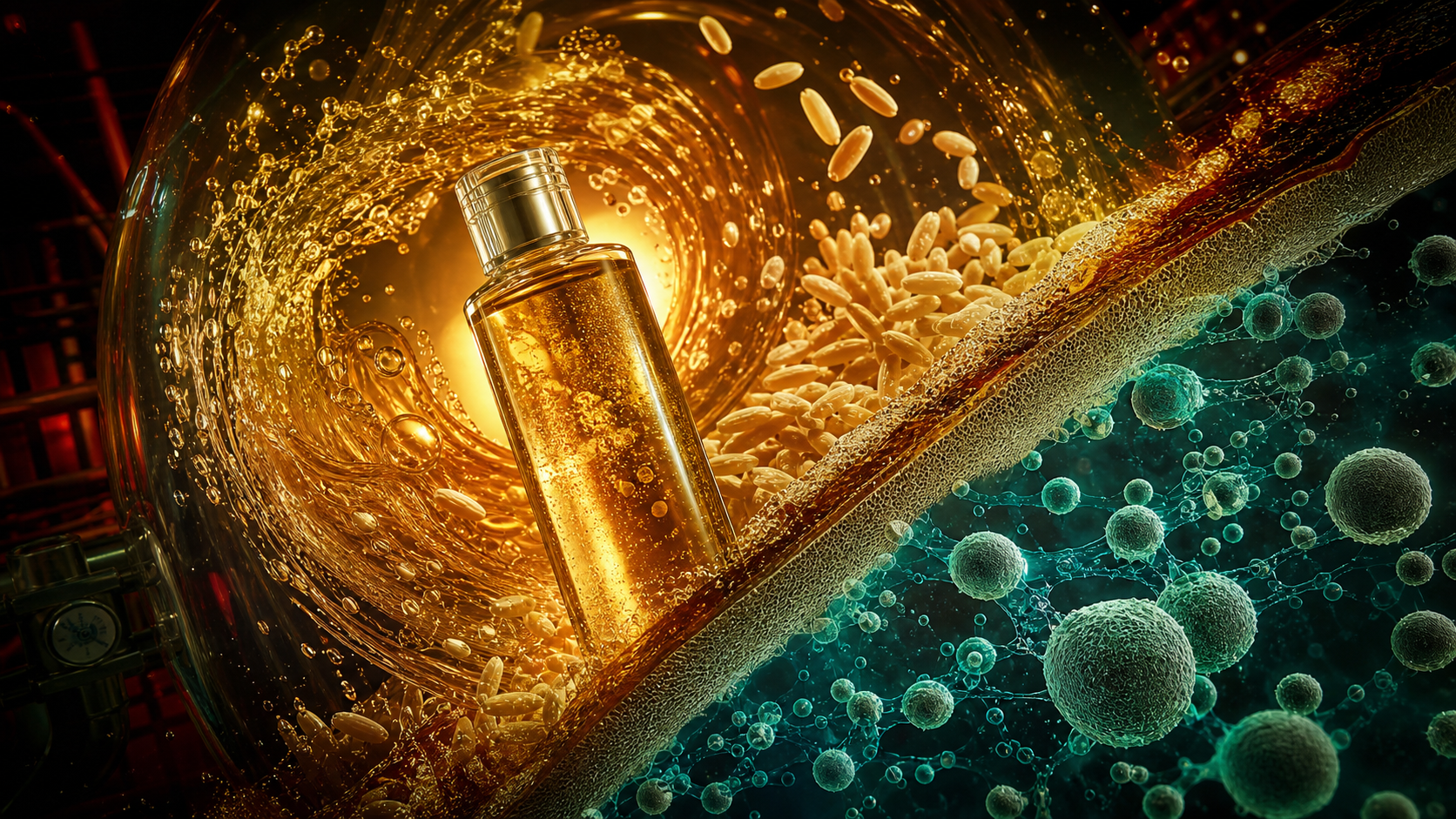
If you've ever stood in a department store and had someone press a small, expensive bottle of clear liquid into your hand while saying the word "essence" like it was a spell, you've met galactomyces. It's the ingredient behind SK-II's Facial Treatment Essence — the "miracle water" that costs more per ounce than some perfumes and comes with a story about Japanese sake brewers who, allegedly, had impossibly youthful hands.
The claim you see repeated everywhere is that galactomyces ferment filtrate is a kind of skincare cheat code: it brightens, refines pores, plumps, and generally makes your face behave. And then, on the other side of the internet, there's a Reddit thread full of people insisting the exact same ingredient wrecked their skin and fed their fungal acne.
Both of these can't be fully true. So we read the ingredient, then went looking for what the actual research says. We went down a bit of a rabbit hole on this one.
Galactomyces ferment filtrate is filtered yeast broth — the leftover liquid after a fungus called Galactomyces ferments a nutrient soup, packed with amino acids, vitamins, and small peptides. There's real lab evidence it nudges skin-barrier and pigment pathways, but most of the strongest human data comes from the brand that sells it, and "ferment filtrate" is batch-variable by nature. The fungal-acne worry is biologically plausible and backed by consistent user reports, not by a controlled study. If your skin likes ferments, great; if you're prone to Malassezia flare-ups, it's a reasonable one to skip. Fragrance-free formulas are the sane place to start.
What galactomyces ferment filtrate actually is
Start with the name, because it tells you almost everything. Galactomyces is a genus of yeast-like fungus. "Ferment" means you fed it something. "Filtrate" means you strained out the cells afterward and kept the liquid.
So galactomyces ferment filtrate is, quite literally, spent fermentation broth that's been filtered clean of the organism that made it. What's left behind is everything the fungus excreted or broke down along the way: free amino acids, small peptides, organic acids, B-vitamins, minerals, and other odds and ends. Our own glossary describes it as "a yeast ferment filtrate rich in amino acids, minerals, and vitamins, used for hydration and skin revitalizing," which is accurate but does the same thing every marketing page does — it makes a batch of strained yeast water sound like a potion.
Here's the honest, slightly awkward part: because it's a biological product, no two batches are identical. Fermentation is a living process. Feedstock, temperature, time, and strain all shift the final mix of molecules. A pharmaceutical active is a defined molecule at a defined dose. A ferment filtrate is a soup, and the recipe drifts. That's not a scandal (soy sauce and wine are the same way), but it does mean "galactomyces ferment filtrate" on two different labels isn't guaranteed to be the same thing at the same strength.
The SK-II origin story, for what it's worth, is real enough: the brand says its "Pitera" was discovered by observing that sake-brewery workers had unusually soft hands, which led researchers to a specific yeast strain. It's a good story. It is also, structurally, a hand-lotion anecdote, not a clinical finding.
How a ferment is supposed to work on skin

The mechanism people imagine is that the yeast "pre-digests" big, useless molecules into small, useful ones your skin can actually absorb. That's roughly right, and it's a decent analogy: fermentation is like having a tiny kitchen full of enzymes chop a whole cabbage into bite-sized pieces before dinner. Amino acids are small and water-loving, so they act as humectants — they hold onto water at the skin surface. That part isn't controversial. Amino acids and their salts are genuinely good humectants, ferment or no ferment.
Where it gets more interesting, and more hyped, is the idea that specific molecules in the filtrate switch on cellular pathways. The one that keeps coming up in the research is the aryl hydrocarbon receptor (AhR), a sensor inside skin cells that responds to certain small molecules and, when activated, can influence how the skin barrier and pigment machinery behave. Some galactomyces components appear to be AhR ligands. That's the biological hook the whole category hangs on.

What the evidence actually shows

This is the part where the internet quietly stops reading, so here's the plain version.
The lab evidence is genuinely interesting. In a 2015 paper in Clinical and Experimental Dermatology, galactomyces fermentation filtrate prevented a Th2-driven drop in filaggrin (a key barrier protein) in cultured skin cells, and it did so through that AhR pathway.1 A 2014 study in the Journal of the American Academy of Dermatology found the filtrate reduced melanin synthesis and oxidative stress in cultured human melanocytes, which is the lab-dish version of "may help the look of dark spots."2 And a 2022 transcriptomic analysis mapped out a whole set of genes the filtrate nudges in keratinocytes.3
Notice what all three have in common: they're done on cells in dishes, not faces. Cultured melanocytes don't have a stratum corneum for the ingredient to fight through, they don't get sun, and they can't tell you their skin looks brighter. In-vitro results tell you a mechanism is possible. They don't tell you it happens at real concentrations, through real skin, at a level your eyes would notice.
There is human data. One study tracking facial pore area, roughness, and redness in young Japanese women reported benefits from a galactomyces-containing antioxidant formula.4 But two caveats matter. First, it's testing a whole formula, not the isolated filtrate, so you can't cleanly credit galactomyces over the other ingredients. Second, a lot of the strongest galactomyces research shares authors or funding with the company that built a billion-dollar franchise on the ingredient. That doesn't make it fraudulent. It does mean you'd want independent replication before treating "clinically proven" as settled, and that independent replication is thin.
So where does that leave the brightening and texture claims? On solid ground as a hydrating, antioxidant-adjacent ingredient with plausible barrier and pigment effects — and on much shakier ground as the transformational glow-in-a-bottle the price tags imply.
The AhR angle is genuinely nerdy and worth a second. The aryl hydrocarbon receptor is the same sensor that responds to pollutants like dioxins — activating it too hard, the wrong way, is bad news. But it's also a normal part of how skin regulates its barrier, and the body has its own AhR ligands. Some researchers now design cosmetic ingredients specifically to be "gentle" AhR modulators. Galactomyces seems to have stumbled into this decades before anyone had the vocabulary for it. Whether that's the reason it works, or a mechanism researchers reverse-engineered after the fact to explain a popular product, is a question the current papers can't fully answer.
The fungal-acne question everyone's actually asking

Here's the concern, stated fairly. Malassezia is a yeast that lives on everyone's skin. In some people, under the right conditions, it overgrows in hair follicles and causes an itchy, uniform, small-bump breakout — Malassezia folliculitis, popularly called "fungal acne."5 Malassezia is lipophilic: it feeds on certain fats and can't easily make its own, so many people who get it learn to avoid specific oils, esters, and fatty acids that seem to feed the flare.
The galactomyces worry follows from two facts. It's a fungal ferment. And people who are prone to Malassezia report, repeatedly and across years of forum threads, that galactomyces essences trigger them. Put those together and you get a very reasonable hypothesis: a ferment from one fungus might contain metabolites that feed another.
But be careful about how strong that chain of logic is. Galactomyces and Malassezia are different organisms; being a "fungal ferment" doesn't automatically mean the filtrate is Malassezia food. We couldn't find a controlled study showing galactomyces ferment filtrate feeds Malassezia or causes folliculitis. What exists is a plausible mechanism plus a lot of consistent anecdotes. That's not nothing; consistent user reports are how a lot of real reactions get noticed first. But it's not the same as established fact, and we're not going to pretend it is.
The practical read: if you don't get fungal acne, the concern probably isn't yours to carry. If you do, and you've already learned your triggers the hard way, treating galactomyces as a "test cautiously or skip" ingredient is completely rational. Patch it, watch for the tell-tale itchy uniform bumps, and don't build your whole routine around it before you know.
What our screening found
Across the 54 products and 1,846 ingredient entries we've screened, the single most-flagged ingredient isn't an exotic active — it's fragrance, which turns up as a mid-risk flag 10 times and as a high-risk flag twice. That's the real backdrop for ferment essences: most of them lean on fragrance and a long extract list to feel luxurious, and the fragrance is a more reliable irritant than anything the yeast is doing. When we screened our Lesschemi Galactomyces Derma Lotion, all 18 of its 18 ingredients came back low-risk, with zero flagged. It's fragrance-free, silicone-free, and paraben-free, and it pairs the ferment with barrier lipids (shea, hydrogenated lecithin, beta-sitosterol) instead of a perfume. The honest cons: shea butter and sea buckthorn oil make it richer than a gel, so very oily skin may find it heavy, and it's a hydrator, not a treatment. No retinol or acid doing targeted work. Benchmarked against derm favorites, it sits right in the mix: Vanicream's five-ceramide cream scores a hair higher for plain barrier repair (9.8), while a popular extract-stacked collagen jelly cream lands lower (8.2) because it carries fragrance and a mid-risk solvent ours skips.
If you want galactomyces without the fragrance gamble that trips up so many ferment products, this is the one that passed cleanly. It's built for normal-to-dry skin that wants barrier hydration — not for someone chasing an active-driven transformation, and not the first thing we'd hand someone mid-Malassezia-flare.

Lesschemi Galactomyces Derma Lotion
Fragrance-free ferment hydration with real barrier lipids; richer than a gel, so oily skin may find it heavy.
Ferments show up on the body, too. Our Seapuri Chicken-Skin Smoothing Body Mist uses a Streptococcus-and-Lactobacillus ferment complex plus niacinamide to smooth the look of rough, bumpy keratosis-pilaris skin, a gentler idea than a harsh acid. But it's a fair comparison for how ferment claims can come bundled with irritants: it's alcohol-based and carries mid-risk flags for menthol and tea tree oil, so it earns a cooling tingle some people won't love. Same lesson, different aisle: the ferment is rarely the thing to worry about; the supporting cast is.
So should you bother?
If your skin is happy and you like the way a ferment essence feels, keep using it — a well-hydrating, antioxidant-leaning layer is a perfectly good thing to own, and galactomyces is a fine version of it. Just calibrate your expectations to "nice hydrating step with some plausible barrier and brightening upside," not "clinically reverses aging," and don't pay perfume prices for the story.
If you're new to it, start with a fragrance-free formula so that if something goes wrong, you can actually tell whether it was the ferment or the perfume. And if you get fungal acne, treat galactomyces as an ingredient to introduce slowly and watch closely — the mechanism is plausible enough, and the anecdotes consistent enough, that caution costs you nothing. For anything that looks like real folliculitis, that's a dermatologist's call and often an antifungal's job, not an essence's.
The best ferment is the one that plays nice with your skin and doesn't smuggle in a fragrance you didn't ask for. That's most of the game. If you want to see how we grade every ingredient before it earns a spot, it's all in how we screen K-beauty ingredients, and if you're weighing formats, toner pads versus toner covers similar ground. The ones that clear our bar end up on the Awards page.
- Takei K, et al., "Galactomyces fermentation filtrate prevents T helper 2-mediated reduction of filaggrin in an aryl hydrocarbon receptor-dependent manner," Clinical and Experimental Dermatology (2015). link
- Kim H, et al., "Galactomyces ferment filtrate reduces melanin synthesis and oxidative stress in normal human melanocytes," Journal of the American Academy of Dermatology (2014). link
- "Transcriptomic Analysis of Human Keratinocytes Treated with Galactomyces Ferment Filtrate, a Beneficial Cosmetic Ingredient," Journal of Clinical Medicine (2022). link
- "Daily Fluctuation of Facial Pore Area, Roughness and Redness among Young Japanese Women; Beneficial Effects of Galactomyces Ferment Filtrate Containing Antioxidative Skin Care Formula," PMC (2021). link
- "Malassezia Folliculitis Presentation, Diagnosis, and Treatment: A Review of 'Fungal Acne,'" Journal of Drugs in Dermatology. link
- SK-II, "Our Story — Discovery of PITERA." link