Keratosis Pilaris: Three Common Fixes, and What the Trials Actually Show for Each
Run a hand up the back of your upper arm. You know within a second whether you have this: small hard bumps, one to a follicle, rough like fine sandpaper, worse in January than in July. In a 1994 postal survey of 49 people with it, 80% said the season changed how it looked.
We opened this one expecting to tell you that laser was the over-sold option and that the tub of 20% urea cream was the sensible, evidence-backed choice. That is the shape the brief had. Then we read the papers and the shape inverted.
So this is a piece about being wrong, written in the order the three fixes fell.
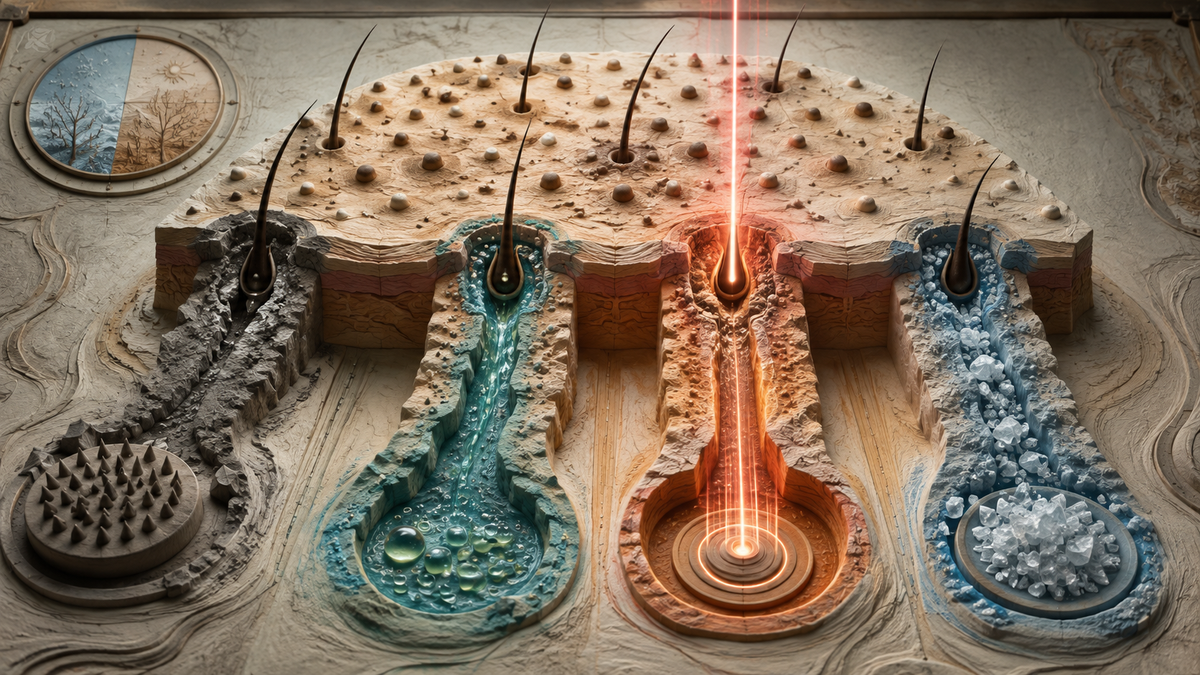
Ranked by how well the studies were built rather than by how invasive the treatment feels, laser comes first, acids second, urea third and physical scrubs last. Laser has three randomised within-subject trials with the untreated arm as the control, one of them sham-irradiated and one published in JAMA Dermatology. The acids have one good split-side trial: 50 people, blinded assessors, 10% lactic acid beating 5% salicylic acid, 66% versus 52% mean lesion reduction over 12 weeks. Urea's flagship 2024 study has no control group at all, no placebo and no blinding, which is a much weaker thing than its reputation suggests. And there is no published controlled trial anywhere that isolates a physical scrub on its own for this condition. We sell a scrub. None of the four changes the natural course of the condition, which for about a third of people improves on its own by their mid-teens.
Twenty-five out of twenty-five had a coiled hair inside
In 2012, Thomas and Khopkar put 25 people with keratosis pilaris under a dermatoscope for the International Journal of Trichology. Every affected follicle they examined had a coiled or circular hair shaft sitting inside it. They extracted the hairs to confirm it rather than calling it from the image. Perifollicular redness showed up in 11 of the 25.

Twenty-five out of twenty-five.
The version most people have heard is that a plug of keratin blocks the follicle and the bump is the plug. This paper argues the sequence runs the other way: a hair grows in a loop, fails to exit, and the keratin builds around the problem. One centre, 25 patients, no control group, so treat it as a strong hint and not a settled mechanism.
It changes how you read every product claim that follows. If part of the bump is a trapped hair, then anything working on surface keratin is addressing a downstream symptom, which fits neatly with the thing every long-term user of these products reports: it comes back within weeks of stopping. The 1994 natural-history survey (83 questionnaires posted, 49 usable) found onset in the first decade of life in 51%, improvement with age in 35%, no change in 43% and worsening in 22%, with a mean age of improvement of 16. That is self-reported, unblinded and now three decades old, and we would not build a treatment decision on it. It is still the only picture of the long arc anyone has published.
The scrub problem, and we sell a scrub
There is no published controlled trial isolating a physical scrub as a monotherapy for keratosis pilaris. Not a small one, not a badly designed one. Every trial we found that involves scrubbing bundles the mechanical step with a leave-on acid, a urea cream or a moisturiser, which means the contribution of the scrubbing itself has never been separated from whatever went on afterwards.

As of August 2026, nobody has run that trial.
We sell a sugar scrub. Beauty Recipe Snow White Ingrown-Hair After-Waxing Scrub scored 9.5 on our screening across 23 ingredients, with sucrose as ingredient 1 and niacinamide at 3. Its free-of chips read "Fragrance-free · Acid-free · Paraben-free · Sulfate-free", and the third and fourth of those are the sort of claim we think actually means something.
The "Acid-free" chip is accurate. It is also the awkward part. No acid of any kind and no urea in 23 ingredients means it is a purely mechanical exfoliant, and mechanical exfoliation is the exact category that has never been isolated in a controlled trial for this condition. We are not going to write around that. The product does what a sugar scrub does, which is take the top off a rough surface and leave the arm feeling smooth for a day or two, and the 2012 dermoscopy work suggests the follicle underneath is untouched by it.
The acids have a controlled trial. Urea does not.
These get lumped together constantly, in shop copy and in dermatology explainers alike, as "keratolytics", one shelf of 3 actives. Evidentially they are not the same thing and the gap is not small.

Kootiratrakarn and colleagues ran the best-designed topical study we found, published in Dermatology Research and Practice in 2015. Fifty people, prospective, randomised split-side: 10% lactic acid on one arm and 5% salicylic acid on the other, allocation randomised per patient, both in a matched vehicle base, examining dermatologists blinded, 12 weeks of treatment with a 4-week follow-up. Mean lesion reduction was 66% for the lactic acid side against 52% for the salicylic acid side, and improvement was visible by week 4.
The honest caveat is that it pits two actives against each other rather than against the vehicle alone, so it tells you 10% lactic acid beat 5% salicylic acid and does not cleanly tell you either beat the base cream. Even with that, it is the only topical KP trial we read with blinded assessors and a within-patient control built into the same protocol.
Urea's headline study is a different animal. McCormick and colleagues tested a 20% urea moisturiser in 30 people over 4 weeks in the Journal of Drugs in Dermatology in 2024, and the paper describes itself as open-label and non-comparative. No vehicle arm. No placebo. No blinding. Skin smoothness and texture improved significantly from baseline at both 1 and 4 weeks, with P values at or below 0.001, and every one of those participants knew they were being treated.
A rich moisturiser applied to dry, bumpy arms for four weeks improves smoothness against baseline. So would a lot of things, including several that cost nothing.
We sell exactly one urea product, the Wellbeing Health Pharm Gounbal Premium Foot Care Cream, whose hero ingredient reads "Urea (Keratolytic) + Glycerin + Hyaluronic Complex".
Gounbal is a foot cream.
The 2025 Cureus review of topical keratolytics for this condition lands roughly where we did. It is a narrative review rather than a systematic one, which limits what you can take from it, and it concludes that keratolytics are reasonable first-line symptom-directed options while the evidence base is "constrained by small sample sizes, heterogeneous outcome measures, limited blinding, and short follow-up". It also states plainly that no intervention alters the natural course of the condition.
Laser is the best-evidenced of the three, which is not what we expected
We had it backwards, and a 2015 JAMA Dermatology paper is where that became undeniable.
Ibrahim and colleagues enrolled 23 people and 18 finished. Each got an 810-nm diode laser on one arm and a placebo on the contralateral arm, three sessions spaced 4 to 5 weeks apart, with raters blinded to which side was which. Roughness and bumpiness scored significantly better on the treated side, a median of 1.0 against 2.0, P=.004. Redness did not improve significantly, P=.11, and redness is the part a lot of people actually want gone. So the trial is a clean result on texture and a null result on colour, in the same 18 people.
Eighteen people finished it.
Maitriwong and colleagues did something similar in 2020 in Lasers in Surgery and Medicine with a 1064-nm Nd:YAG device, 23 completers, four treatments at 4-week intervals, and here the control arm received sham irradiation rather than nothing. Roughness dropped significantly against the sham side, P<0.001. One detail worth flagging: the paper's title calls it double-blind while its methods section describes a single-blind design. That inconsistency does not sink the study, but it is the kind of thing we would rather point at than quietly smooth over.
The third is the one that puts the two categories head to head. Ismail and Omar treated 60 Egyptian patients in the Journal of Cosmetic Dermatology in 2020, split-body again, fractional carbon dioxide laser on one side for two sessions four weeks apart, topical 10% urea on the other side as the comparator. Excellent or good improvement was recorded in 60% to 93% of the laser sites depending on the outcome measured, against improvement described as minimal on the urea sides. Patient satisfaction favoured the laser at P<.001.
Now the deflating part. Eighteen, 23 and 60 participants. All single-centre, and all with follow-up measured in weeks rather than years, so none of them tells you what the arm looks like a year on. Laser wins the evidence-quality ranking because the comparison arms are properly built into the design, not because anybody has proved a durable result. It also costs several hundred pounds a course and needs a clinic, and it is not something we sell or could sell.
What our screening found
The most important thing on this page is a claim of ours that is wrong. Seapuri Body Mist scored 9.1 across 32 ingredients and its free-of chips read "Parfum-free · Allergen-free · Paraben-free · Colorant-free". The "Allergen-free" chip is false. The formula contains lavender flower extract at 10, clary extract at 11, anise fruit extract at 16, menthol at 21 and tea tree leaf oil at 32, and our screening grades all five as mid risk precisely because they are recognised fragrance allergens whether or not the word "parfum" appears on the box. Alcohol also sits at position 3 of 32, high enough in the list to matter on skin you have just scrubbed. That chip needs to come off, and it is the second time our own chip logic has failed the way we described in our own fragrance-free audit. The scrub's chips hold up better: "Acid-free" is true, and it is true in a way that costs the product something, because it means the one thing in this article with no isolated controlled evidence behind it is the thing we stock. Against a catalogue mean of 9.30, a 9.5 and a 9.1 are a good ingredient screen and not a treatment result, and the two are easy to confuse.

Beauty Recipe Snow White Ingrown-Hair After-Waxing Scrub
Purely mechanical, with no acid and no urea in 23 ingredients, which puts it in the one category with no isolated trial behind it for these bumps. Sucrose is ingredient 1 and niacinamide 3, and it is a smoothing and post-waxing product rather than anything that reaches the follicle.

Carries an "Allergen-free" chip it does not deserve, with five mid-risk botanical allergens including tea tree oil and menthol, plus alcohol at position 3 of 32. Skip it entirely if your arms are reactive or freshly exfoliated; it is a light finishing mist, not a treatment.
The practical takeaway
If you want the option with the strongest study designs behind it, it is laser, and we don't sell it, can't sell it, and would gain nothing by telling you so. Three randomised within-subject trials with blinded raters is more than the topicals have between them.

If you want something you can start this week, buy a 10% lactic acid lotion and give it 12 weeks, because that is the concentration and the timeline in the only properly controlled topical trial in this article. Not urea, whose 30-person study had nothing to compare itself against. And not a scrub on its own, ours included.
Anything inflamed, scarring or leaving thinned patches of skin is a different conversation and belongs with a dermatologist rather than with any of the 4 options above.
The rest is maintenance. Nothing in the literature we read changes the underlying condition, roughly a third of people improve without doing anything by their mid-teens, and 80% of that 1994 cohort found winter made it worse regardless. Our screening criteria grade what is in a bottle, which is a narrower job than deciding whether a category works, and this article is the clearest example we've published of the two answers pointing in different directions.
- Kootiratrakarn T, Kampirapap K, Chunhasewee C, "Epidermal permeability barrier in the treatment of keratosis pilaris," Dermatology Research and Practice 2015:205012 (2015). link
- McCormick E, Nussbaum D, Friedman A, et al., "Evaluation of a Moisturizing Cream with 20% Urea for Keratosis Pilaris," Journal of Drugs in Dermatology 23(1):1274–1277 (2024). link
- Ibrahim O, Khan M, Bolotin D, et al., "Treatment of Keratosis Pilaris With 810-nm Diode Laser: A Randomized Clinical Trial," JAMA Dermatology 151(2):187–191 (2015). link
- Maitriwong P, Tangkijngamvong N, Asawanonda P, "Innovative 1064-nm Nd:YAG Laser Significantly Improves Keratosis Pilaris, A Randomized, Double-Blind, Sham-Irradiation-Controlled Trial," Lasers in Surgery and Medicine 52(6):509–514 (2020). link
- Ismail S, Omar SS, "Clinical and dermoscopic evaluation of fractional carbon dioxide laser in management of keratosis pilaris in Egyptian type skin," Journal of Cosmetic Dermatology 19(5):1110–1120 (2020). link
- Thomas M, Khopkar US, "Keratosis pilaris revisited: is it more than just a follicular keratosis?" International Journal of Trichology 4(4):255–258 (2012). link
- Poskitt L, Wilkinson JD, "Natural history of keratosis pilaris," British Journal of Dermatology 130(6):711–713 (1994). link
- Dampa E, "The Effectiveness of Topical Keratolytics (AHA/BHA/Urea) in Treating Keratosis Pilaris: A Review of the Literature," Cureus 17(12):e100507 (2025). link