Sebaceous Filaments Aren't Blackheads. A Nose Strip Lifts the Same Thing Off Everyone, Including People With Clear Skin.
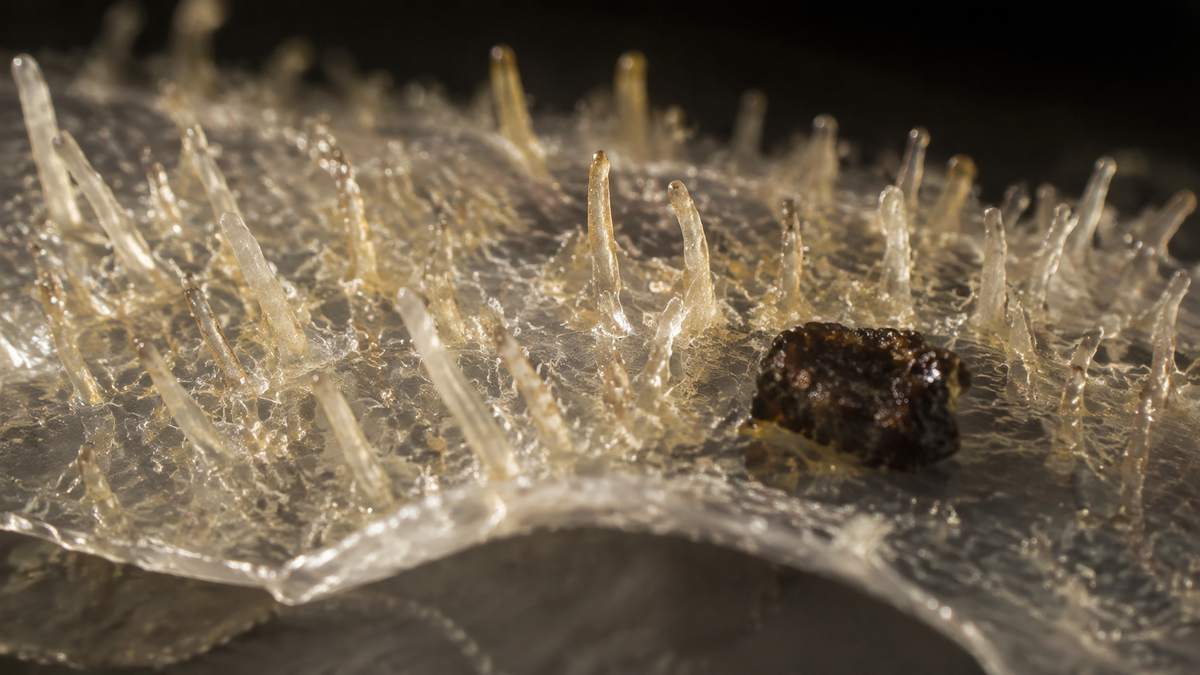
Pull a nose strip off, turn it over, and look at it under a lamp. You get a field of pale columns standing up off the adhesive, each one a couple of millimetres long, slightly waxy, darker at the tip. It is one of the most satisfying things in skincare, and roughly nobody is looking at what they think they are looking at.
Those columns are follicular casts. They are the contents of a normal sebaceous follicle, moulded into the shape of the tube they were sitting in. A person with visibly clear skin will produce a strip that looks much the same as yours.
We should say straight away that the product we sell in this category is not a tear-off strip. It is an acid pack, and it works by a different route entirely, which we will get to. We are writing about the tear-off kind because it is the one that generates the photograph.
A blackhead is a lesion: a follicle plugged with compacted keratin that has darkened at the surface. A sebaceous filament is not a lesion at all — it is the ordinary lining of a working oil pore, present in essentially every sebaceous follicle on a nose. A strip removes the second thing, which is why the result looks dramatic and why the pore does not stay empty. Dermatologists collect the same material on purpose, using cyanoacrylate rather than a rubber-based adhesive, and they call it a follicular cast. We went looking for a measured refill time and could not find one.
What comes off is a cast, not a plug
A sebaceous follicle is a tube. Sebum is made at the bottom of it, keratinocytes shed into it along the way, and the mixture works its way up and out onto the skin. The material sitting inside that tube takes the shape of the tube. Lift it out intact and you have a cast of the follicle, complete with the little dark cap where the tip has been sitting in contact with air.

The dark cap is the part that fools people. It looks like the head of a blackhead because it darkens for the same reason: exposure. Melanin and oxidised lipid at the surface, not dirt, and not a different substance from the rest of the column.
A comedo is a different object. It is a follicle that has become functionally blocked, with keratin compacted into a plug that the follicle can no longer clear on its own. The 1987 paper on functional blockage of open comedones is the piece of work that sits behind that distinction, and the clinical literature on comedone formation has treated blockage as the defining feature ever since.
One is a working pore doing its job. The other is a pore that has stopped.
Dermatology has a name for the thing you're doing
Cyanoacrylate skin surface stripping has been in use since the 1970s, and it does exactly what a pore strip does, with better adhesive and a microscope waiting at the other end. A drop of cyanoacrylate on a slide, pressed to the skin, lifted after it sets. What comes away is described in the literature as a continuous sheet of stratum corneum with horny follicular casts attached.

Researchers use it because the cast is worth having. Thielitz and colleagues analysed the lipids in follicular casts collected this way to measure whether anti-acne treatments were changing what the follicle produced, publishing the method in the British Journal of Dermatology in 2001. Piérard's group at Liège has written about the same technique as a cheap diagnostic in settings without a lab.
The casts are not the disease. They are the sample.
Why the strip keeps working, forever
Sebum production does not pause because you removed the sebum. The follicle refills, the material re-forms into the shape of the tube, and the tip darkens again on contact with air. This is why nobody ever finishes a box of pore strips and finds the problem solved, and why the before-and-after photograph is always available.

We wanted to tell you how long that takes, and we cannot. We looked for a study that removed follicular casts and then measured the rate at which they re-formed on the same follicles, and we did not find one. There is a good literature on sebum output rates and a good literature on comedone counts in acne trials, and a gap where this specific question should be.
The oldest paper we could find that treats sebaceous filaments as a subject in their own right is from the 1970s, in German, and we could not get the full text. That is roughly the state of it. A structure present on almost every adult nose, photographed millions of times a week, and the reference we keep landing on is fifty years old and behind a language barrier.
The acid route, which is what we actually sell
The alternative to pulling is dissolving, and that is the mechanism our own product uses. Acids that are soluble in oil can get into the follicle and loosen the keratin holding the cast together, so the material clears the way it was going to clear anyway, faster.
Salicylic acid is the one everybody knows. Capryloyl salicylic acid, sold as LHA, is salicylic acid with a fatty tail on it, which changes how it partitions and how deep it goes. Lactic acid and gluconolactone work on the surface rather than inside the follicle. Our nose pack has all four in it plus a willow bark extract, which is the botanical route to the same salicylate chemistry.
This has an honest limitation. Acids do not empty a pore in fifteen minutes the way a strip does, so there is no photograph at the end. What you get instead is a follicle that clears a bit more readily over weeks, which is less satisfying and more likely to still be working in a month.
If a bump is deep, sore and closed rather than open at the surface, none of this applies to it. That is a different lesion and a strip will do nothing to it except irritate the skin on top. Deep or persistent inflammatory acne is a conversation with a clinician, not with a nose pack.
What our screening found
Our nose pack scores 9.2, and four of its thirty-four ingredient rows carry a mid flag from us: salicylic acid, capryloyl salicylic acid, lactic acid, and peppermint oil. Three of those four are the working ingredients — the flags are the point of the product, not a defect in it. The peppermint oil is the one worth arguing about, because it is there for the cooling sensation rather than for the follicle, and an essential oil on already-acidified skin is a cost with no mechanism behind it. We would take it out. We do not make the product, so we are saying it here instead.

HATHERINE Pore Melting Shrinko Nose Pack 4ea
Four acids and a willow bark extract rather than an adhesive. No dramatic photograph at the end. Contains peppermint oil, which we flag and would rather it did not.
The practical takeaway
Look at where the dark dots are. Sebaceous filaments are small, evenly spaced, greyish rather than black, and they cover the whole nose and the sides of it in a regular pattern. Blackheads are larger, darker, scattered rather than uniform, and there are fewer of them.

If the pattern is uniform, you are looking at anatomy. Removing it is a cosmetic act with a short half-life, which is a perfectly reasonable thing to want before a photograph.
If you want the pore to look smaller for longer, the lever is what the follicle is producing and how readily it clears, and that means an oil-soluble acid used regularly rather than a strip used occasionally. We have written about how salicylic acid turns up in ten of the products we sell and how easy it is to stack it without noticing, which is the failure mode to watch for here. Our scoring method is on the awards page.
And one thing not to do. Strips pull on skin, and pulling repeatedly on the same skin has a cost that no amount of satisfying photograph offsets. Once a week is not a routine, it is a habit with a picture attached.
- Thielitz A et al. "Lipid analysis of follicular casts from cyanoacrylate strips as a new method for studying therapeutic effects of antiacne agents." British Journal of Dermatology 145(1), 2001. PMID 11453902.
- Piérard GE et al. "Cyanoacrylate skin surface stripping and the 3S-Biokit advent in tropical dermatology: a look from Liège." The Scientific World Journal 2014;2014:462634. PMID 25177726.
- "Functional blockage of open comedones." PMID 2958075.
- "[Sebaceous filaments (author's transl)]." PMID 130839 — German-language, full text not obtained.
- "Comedone formation: etiology, clinical presentation, and treatment." Clinics in Dermatology, 2004.
- DHALIORA screening data: 56 products, 1,920 ingredient rows, full recount 2026-09-06.