Copper Peptides: 'Botox in a Bottle,' or Just Very Blue Hype?
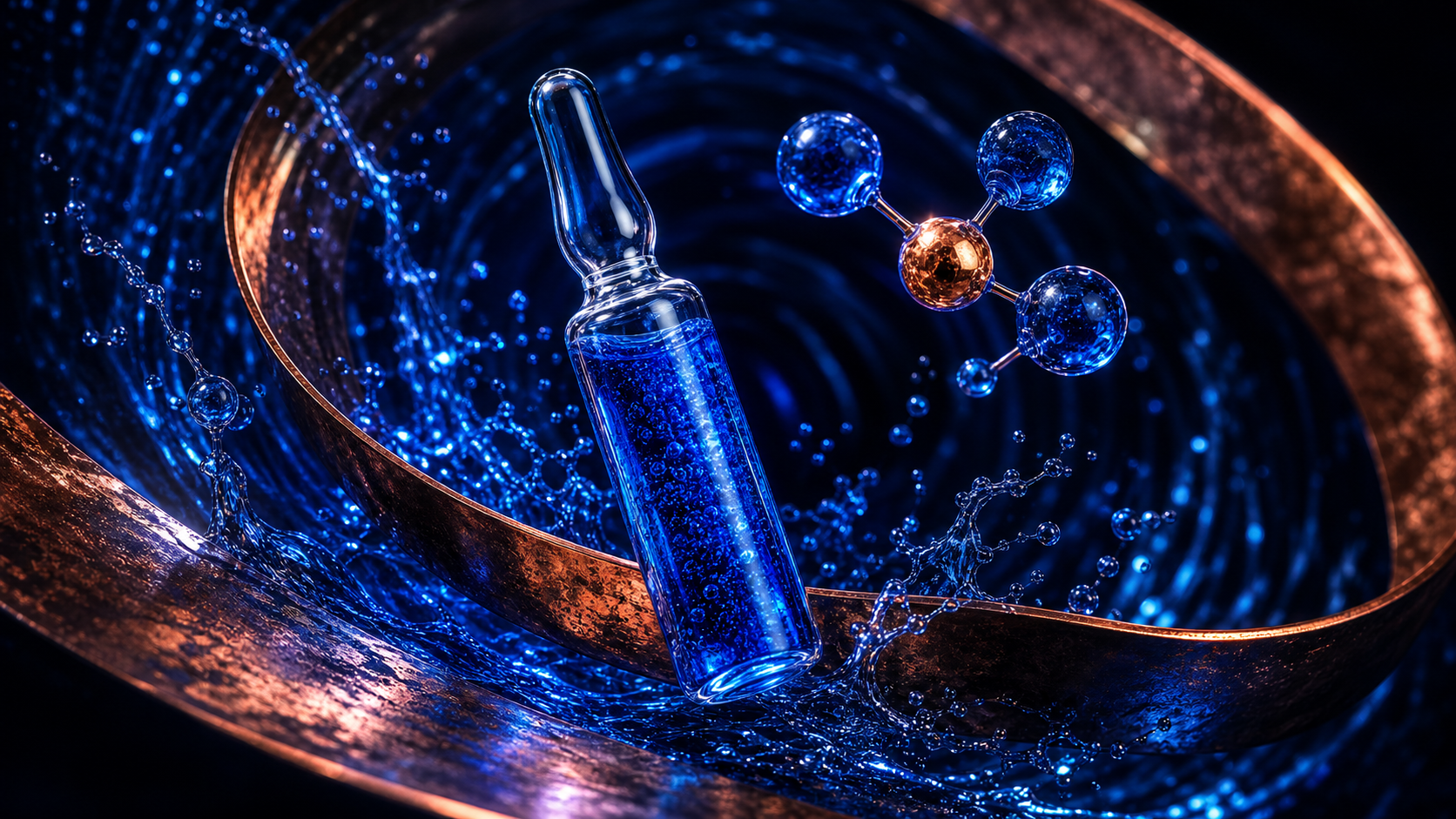
You've seen the serum. The one with the almost radioactive blue liquid, sitting on a bathroom shelf in every "10 steps that changed my skin" video, promised to you as "Botox in a bottle." The pitch is always some version of the same thing: this tiny molecule tells your skin to rebuild itself, so you get firmer, smoother, younger-looking skin without a needle. The hero ingredient is usually written two ways on the box: copper tripeptide-1 in the fine print, and copper peptides GHK-Cu in the marketing.
It's a genuinely interesting molecule. It's also one of the most oversold ingredients in the skincare aisle right now, and the gap between what the research shows and what the subway ad implies is wide enough to drive a truck through.
So let's do the honest version. What GHK-Cu is, where the famous "regeneration" story actually comes from, whether any of that survives being smeared on your face, and why it's blue. We went down a bit of a rabbit hole on this one.
GHK-Cu is a naturally occurring copper-carrying tripeptide, and the science behind it is real, but most of the headline "regeneration" data comes from cells in a dish, animals, and injected or wound-healing studies, not from creams on intact skin. The topical human evidence is thinner: small studies suggest it may help the look of fine lines and firmness, which is a reasonable "supporting peptide," not a Botox substitute. It doesn't paralyze muscles, so "peptide-tox" is marketing, not mechanism. It also doesn't love sharing a routine with direct vitamin C or strong acids. Blue color = the copper, nothing more.
What copper peptides (GHK-Cu) actually are

GHK stands for glycyl-L-histidyl-L-lysine: three amino acids strung together into a short chain called a tripeptide. On its own it's just a peptide. The magic ingredient is the "-Cu" on the end: a copper ion (Cu²⁺) that the peptide grabs and holds. Together they form GHK-Cu, or in cosmetic-label language, copper tripeptide-1.
This isn't some lab invention. GHK occurs naturally in human blood plasma, and its levels drop as we age, from around 200 nanograms per milliliter in your twenties to about 80 by your sixties, which is the stat every copper-peptide brand loves to quote. The peptide has a real talent for binding copper, and copper happens to be a cofactor your body needs for a whole list of skin-building enzymes, including the ones that cross-link collagen and elastin.
Think of the peptide as a courier and the copper as the package. The GHK part is a molecular hand that's shaped to hold a copper ion and carry it to where cells can use it. That's the elegant part of the biology, and it's why the ingredient has been studied for fifty years. Our own screening glossary files copper tripeptide-1 as "a copper-bound tripeptide that signals hair follicle regeneration" — a fair summary of the lab literature, but hold those words "signals" and "regeneration," because in a cosmetic on intact skin they're doing a lot of work.
Where the "regeneration" story comes from
Here's the thing nobody putting GHK-Cu on a serum box wants to say out loud: the impressive research is mostly not about serums.
The foundational work (much of it by Loren Pickart, who first isolated GHK back in the 1970s) shows that GHK-Cu does striking things in the right setting. In cell cultures it ramps up collagen and glycosaminoglycan production. In wound-healing and tissue-repair models, it improves how quickly and cleanly damaged tissue rebuilds. A 2018 gene-expression review found that GHK can shift the activity of a huge number of human genes, nudging many of them back toward a more "youthful," repair-oriented pattern. That sounds like science fiction, and it's real data.
But look at where the data lives. A lot of it is in vitro — cells in a dish, bathed directly in the compound, with no skin barrier in the way. A lot of the rest is in animals, or involves the peptide being injected, or applied to broken skin during wound healing. When your skin is wounded, the barrier that normally keeps big molecules out is gone, so of course more of the peptide gets in and does more.
A better analogy: GHK-Cu is a bit like a repair crew that shows up to a demolished building and helps rebuild it beautifully. Impressive. It does not follow that the same crew, handed to you at the front door of an intact, undamaged house, will let themselves in and start upgrading the plumbing. Intact skin is specifically designed to keep molecules like this out.

What the topical evidence actually shows

Does any of it survive being put in a cream? Some, yes, but the human topical evidence is smaller and softer than the cell-and-wound data.
There are a handful of small clinical studies on copper-peptide facial products. One often-cited trial on photoaged skin reported improvements in the look of fine lines, skin density, and thickness over several weeks of use. A study on skin recovering from CO₂ laser resurfacing found copper-tripeptide cream was associated with faster-looking healing and less redness. These are encouraging. They're also small, sometimes industry-linked, and measuring appearance and self-assessment more than hard tissue biopsies.
And there's the delivery problem. Copper peptides are water-loving and not tiny, and a couple of penetration studies suggest the copper complex doesn't cross the intact barrier easily on its own. Formulators know this. It's why serious peptide serums fuss over pH, delivery systems, and pairing peptides with penetration helpers. A peptide that can't get past the top layer of dead cells is just an expensive way to hydrate your stratum corneum.
Our honest read: GHK-Cu is a reasonable supporting active. It belongs in the same mental bucket as other signal peptides — a "may help the look of firmness and fine lines over months of consistent use" ingredient, not a hero that rebuilds your face. If you've read our take on whether PDRN skincare works, this will feel familiar: real molecule, real lab data, marketing that sprints several steps ahead of the topical human evidence.
Why is it blue? Pure GHK peptide is basically colorless. It's the copper doing it. Copper(II) ions in a watery, peptide-bound complex absorb light in the red-orange part of the spectrum and reflect blue, the same basic reason copper sulfate crystals are that vivid blue and old copper roofs weather to teal. So the striking color isn't a dye or a gimmick — it's a rough visual cue that copper is actually complexed in there. Handy, though it tells you nothing about concentration or whether the formula will deliver.
"Peptide-tox" and the Botox-in-a-bottle claim, decoded
This is where the marketing gets slippery. You'll see copper peptides folded into products branded "pepta-tox," "peptide-tox," or "Botox in a bottle." It's worth separating two totally different ideas that these names smush together.
GHK-Cu does not work like botulinum toxin. Botox relaxes muscles by blocking nerve signals. GHK-Cu is a repair/signaling peptide — a completely different mechanism that has nothing to do with paralyzing anything. So "copper peptides = needle-free Botox" is just wrong on the biology.
What's actually happening in a lot of "tox" serums is that they also contain a separate class of ingredients: so-called neuropeptides like argireline (acetyl hexapeptide-8), or newer bioengineered botulinum-type polypeptides, meant to mimic a muscle-relaxing effect topically. The evidence that these do anything meaningful through intact skin to expression lines is, to put it gently, modest. When a product stacks copper peptides and a "tox" peptide, the blue color and the copper story do the emotional selling, while a different molecule carries the "Botox" implication. Neither claim is as settled as the box wants you to believe.
The catch: what not to mix it with

Copper peptides are a little high-maintenance about their neighbors. Two practical conflicts worth knowing:
Direct vitamin C (L-ascorbic acid). Copper is a redox-active metal, and pairing free copper with pure ascorbic acid can drive oxidation reactions that degrade both ingredients: you can end up with less of each, and potentially some pro-oxidant byproducts. Most formulators just tell you not to layer a copper-peptide serum and a strong vitamin C serum in the same step. Use one in the morning and the other at night, and you sidestep the whole argument.
Strong acids and low pH. Peptides in general are happiest around neutral pH. Very low-pH products (a strong glycolic or salicylic acid exfoliant, for instance) can destabilize the copper complex or the peptide bonds. Again, the fix is simple: separate them, morning and night, or alternate days. You don't have to abandon your acids; you just don't want to pour them on top of your copper peptides.
None of this is a safety scare. It's formulation chemistry. But it's the kind of thing the "just layer everything" content never mentions.
When we screened our copper-peptide products, the picture was reassuring on safety and honest on limits. Across the 54 products we've screened so far (1,846 ingredient entries, of which 1,665 grade low-risk, 173 mid, and just 8 high), copper tripeptide-1 itself consistently screens low-risk. It's a well-tolerated ingredient. Our Lacelltix Pepta Tox Ampoule runs 35 of its 39 ingredients at low-risk (a 9.7/10 formula screen), pairing GHK-Cu with Matrixyl peptides, niacinamide, and a multi-weight hyaluronic-acid cascade. But we flag four ingredients at mid-risk, and two matter to you: it contains Fragrance, and (true to the "pepta-tox" name) a bioengineered botulinum-type polypeptide (sr-Oligopeptide-91/Clostridium Botulinum Polypeptide-1) with limited long-term topical data. That's exactly the "tox peptide" we just decoded. Not a red flag, but a patch-test-first situation. On the scalp side, our COSNORI 8GROW tonic uses copper peptides alongside its functional actives, and we flag its alcohol base, rosemary leaf oil, menthol, and salicylic acid, all mid-risk because they're common irritants, not because they're dangerous. Salicylic acid and menthol are among the mid-risk actives we log most often across our shelf. Cooling and effective for a lot of people; a problem for sensitive scalps. We tell you both.
What passed our screening
If you want copper peptides done as a genuine multi-active serum rather than a single-ingredient gimmick, the Lacelltix ampoule is the one that cleared our desk. It doesn't rely on GHK-Cu alone. It layers it with Matrixyl-type peptides and a hydration base that simpler "just hyaluronic acid" serums skip. In our benchmark against a popular Amazon PDRN peptide serum (Medicube's, which we scored 8.5), the Lacelltix kept a cleaner hydration base without the comedogenic isopropyl myristate and extra ethoxylates.

Lacelltix Skin Recovery Pepta Tox Ampoule
Copper tripeptide-1 plus Matrixyl peptides and a multi-weight HA cascade, but it's fragranced and includes a novel botulinum-type peptide, so patch test first.
Who should skip it? Anyone with a known fragrance sensitivity, and anyone who wants to avoid experimental "tox" peptides until there's more long-term data. There's no shame in wanting a plain, boring, single-peptide serum — this isn't that.
For the scalp, copper peptides show up in leave-on tonics aimed at shedding and tired scalps. If that's your interest, read our full breakdown of whether hair-loss shampoos actually work first, because the honest answer there matters: cosmetic scalp tonics support the scalp environment, but hair loss is a medical condition, and minoxidil and a dermatologist beat any tonic on evidence.

COSNORI 8GROW Anti-Hairloss Pro-Vitamin B5 Hair Tonic
Copper peptides with pro-vitamin B5, salicylic acid and cooling menthol: a functional cosmetic tonic, not a medical treatment. Alcohol-and-menthol base, so sensitive scalps should patch test.
Both products, and the reasoning behind how we graded them, sit under our Awards and screening framework.
So, hype or science?
Both, honestly — and the split is the whole point. GHK-Cu is a real molecule with fifty years of real research behind it, and if you enjoy a well-formulated copper-peptide serum as part of a consistent routine, that's a perfectly good choice. Just calibrate your expectations to the topical human evidence, not the injected-and-in-a-dish evidence. It's a supporting peptide that may help the look of firmness and fine lines over months. It is not a needle replacement, it doesn't paralyze anything, and it won't rebuild your dermis from the outside.
Practically: use it consistently, give it a couple of months, and don't sabotage it by layering it directly under a strong vitamin C or a low-pH acid. Patch test anything labeled "tox," because those extra peptides (not the copper) are the wild cards. And if it's the color that sold you, enjoy the blue for what it is. It's just copper doing its thing.
- Pickart L, Margolina A. "Regenerative and Protective Actions of the GHK-Cu Peptide in the Light of the New Gene Data," International Journal of Molecular Sciences (2018). link
- Pickart L. "The human tri-peptide GHK and tissue remodeling," Journal of Biomaterials Science, Polymer Edition (2008). link
- Pickart L, Vasquez-Soltero JM, Margolina A. "Skin Regenerative and Anti-Cancer Actions of Copper Peptides," Cosmetics (2018). link
- "Effects of Topical Copper Tripeptide Complex on CO₂ Laser-Resurfaced Skin," Archives of Facial Plastic Surgery (2006). link
- "Biological activities of selected peptides: skin penetration ability of copper complexes with peptides," indexed on PubMed (2008). link
- "Copper Peptides: Benefits for Skin and Hair Care, and How to Use Them," Healthline (medically reviewed). link