PDRN Skincare: Does Salmon Sperm Actually Regenerate Your Skin?
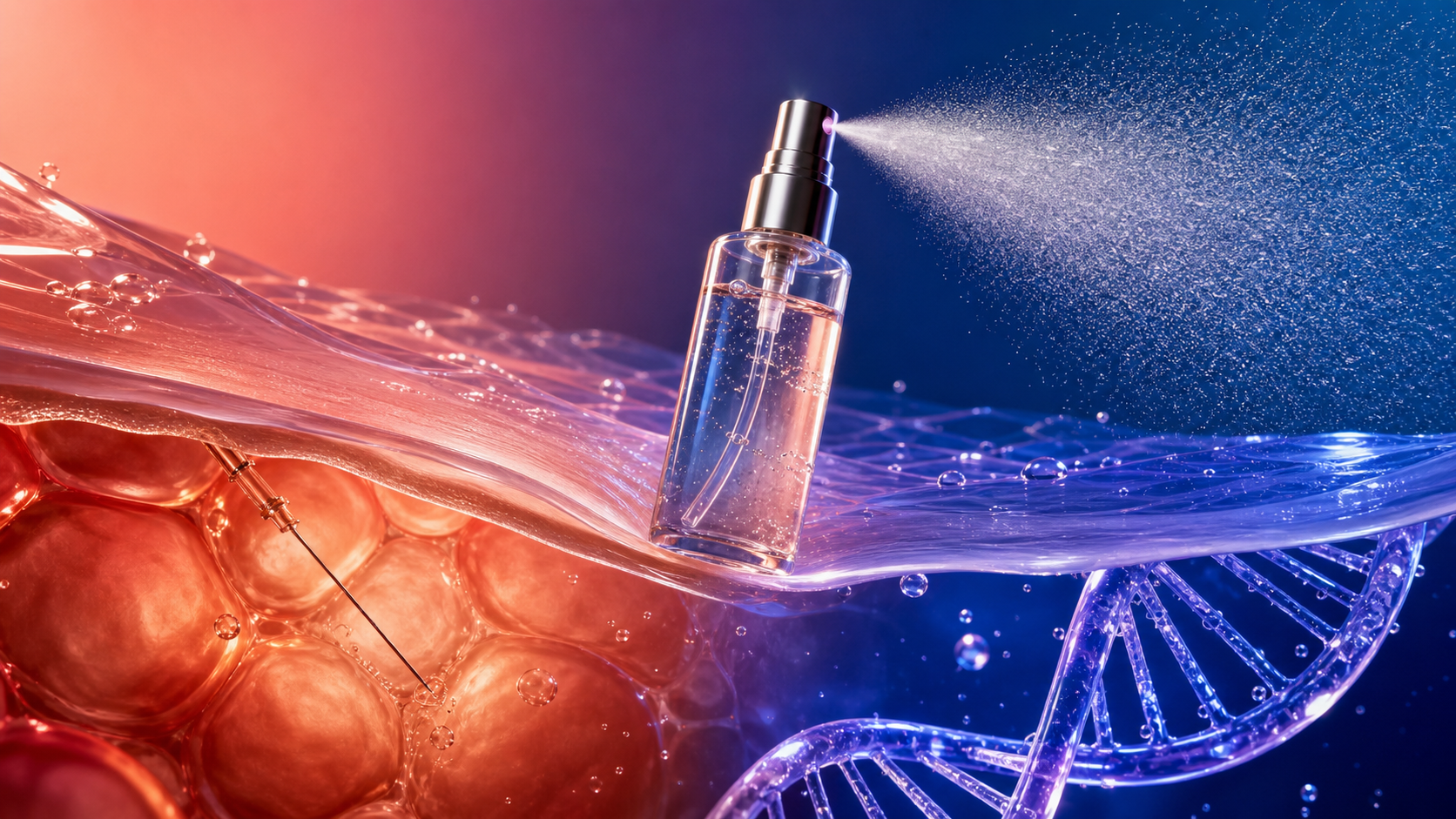
You've seen the claim by now. A dewy little serum bottle, a caption that says it's made from "salmon sperm," and a promise that it will regenerate your skin like you're a wounded fish healing its own fin. Kim Kardashian got the injectable version on camera. The topical version showed up in every Sephora haul video by early 2026. And the word doing all the heavy lifting is regenerate.
So let's actually look at it. PDRN skincare is the biggest K-beauty trend ingredient of the moment, and the question underneath all the hype is simple: does rubbing DNA fragments on your face do anything the marketing says it does?
Short answer, we went down a rabbit hole on this one. The molecule is real, the science behind it is real, and most of that science was done with a needle — not a spray bottle.
PDRN (polydeoxyribonucleotide) is a mix of short DNA fragments, usually purified from salmon or trout milt because that DNA is a close match to ours and rarely triggers immune reactions. There's genuinely good evidence it helps tissue repair — but almost all of it comes from injected PDRN used in clinics for wounds, ulcers, and post-laser recovery. Topical PDRN is a much thinner evidence base, mostly because a large DNA molecule struggles to cross intact skin. Whether it's "salmon" or the newer vegan plant-derived versions matters less than people think. As a hydrating, soothing serum ingredient it's a reasonable bet. As "regeneration in a bottle," the honest verdict is: not proven.
What PDRN skincare actually is
Polydeoxyribonucleotide is exactly what the long name says: a polymer of deoxyribonucleotides. DNA, chopped into short pieces, typically fragments running from about 50 to 1,500 base pairs long. On an ingredient list you'll often see it written as Sodium DNA, which is just the sodium salt of that fragmented DNA. Our glossary describes Sodium DNA plainly: the sodium salt of DNA used for skin-conditioning claims. Not a mystery, not a miracle.
Why salmon? Two reasons, and neither is glamorous. Fish milt (the reproductive fluid, yes, that's the "salmon sperm" part) is a cheap, abundant source of DNA. And salmonid DNA is structurally similar enough to human DNA that your immune system largely ignores it, which keeps the purified material low-irritation. It's a sourcing decision, not a magic ingredient from a specific fish.
That "salmon sperm" framing is pure marketing theater, by the way. What ends up in the bottle is purified, sterilized, fragmented DNA. There is no sperm in your serum. It's the kind of gross-out detail that makes a product go viral, which is presumably the point.
How it's supposed to work

There are two proposed mechanisms, and they're worth separating because people blur them together.
The first is the salvage pathway. Your cells build new DNA and RNA either from scratch (expensive, slow) or by recycling ready-made nucleotide pieces (cheap, fast). The idea is that PDRN, once broken down, hands cells a bag of pre-made building blocks so they can crank out new tissue without doing all the assembly work themselves. Think of it like a contractor who normally has to mill their own lumber suddenly getting a delivery of pre-cut boards. Building goes faster because a slow step got skipped.
The second is receptor signaling. PDRN and its breakdown products act as an adenosine A2A receptor agonist, switching on a receptor that's tied to reducing inflammation and nudging cells toward growth and new blood vessel formation. This is the mechanism with the most direct experimental support, and it's why PDRN keeps showing up in wound-healing research.
Both of these are plausible. Both are supported in lab and clinical settings. Here's the catch that the "haul" videos skip: those settings almost always involve getting PDRN into the tissue, past the skin's outer barrier. Which is a very different thing from spraying it on top.

What the evidence actually shows

Let's split this cleanly, because the honesty here is the whole point.
Injected PDRN has a real track record. Reviews of the wound-healing literature describe PDRN accelerating repair in diabetic foot ulcers, burns, post-surgical wounds, and skin grafts, plus use in tendinopathy and post-laser recovery. A 2021 review in Pharmaceuticals lays out the mechanisms and the tissue-repair data in detail. More recent dermatology reviews from 2024–2025 cover its use in aesthetic clinics for skin quality and "regenerative" protocols. When PDRN is delivered by needle, intradermally or into a wound bed, there's a genuine, if still-maturing, body of evidence behind it.
Topical PDRN is a much thinner story. And there's a straightforward reason. DNA fragments are big, water-loving molecules, and your stratum corneum, the outermost layer of skin, is very good at keeping big water-loving molecules out. That's its job. A 500-base-pair DNA fragment is orders of magnitude larger than the small, oil-friendly molecules that slip through easily. So the central question for any topical PDRN product isn't "is PDRN active?" It's "does meaningful PDRN even get past the front door?" And on that, published, independent evidence is scarce. A lot of what circulates is manufacturer testing or small studies without controls.
Dermatologists have been blunt about this gap. In a Dermatology Times piece pointedly titled "Social Media Mythbusters: PDRN Serums," the takeaway is that the exciting regenerative data is from injectables, and topical serums shouldn't be assumed to do the same thing. That's not us being cynical — that's the field's own reading.
None of this means topical PDRN is useless. A serum built around Sodium DNA and a pile of humectants will absolutely hydrate and soothe. It may support the look of skin barrier recovery. Those are real, if modest, cosmetic benefits. They're just not "regeneration," and the leap from "helps skin feel better" to "regenerates tissue like the injections do" is the leap the marketing quietly makes for you.
Here's the twist nobody in the haul videos covers. If PDRN's benefit really comes from delivering nucleotide building blocks and switching on the A2A receptor, then the source of the DNA shouldn't matter much: salmon, trout, or the newer vegan versions extracted from plants. A fragment of DNA is a fragment of DNA; your salvage pathway doesn't check for a fish. Our own White Lotus serum uses Sodium DNA derived from white lotus rather than fish, which sidesteps the ick factor and the vegan objection entirely. Is that a meaningful upgrade or a clever repositioning of the same molecule? Honestly, probably the latter — and that's kind of the point. If the molecule is what matters, "salmon" was never the hero. It was just the story.
What our screening found
We've screened 54 products and 1,846 individual ingredient entries so far. Of those, 1,665 came back low-risk, 173 landed in our mid-risk band, and only 8 hit high-risk. Fragrance is our single most-flagged mid-risk entry, showing up in 10 products — which is relevant here, because both PDRN products we curated in this category carry added fragrance. When one of our own picks contains something we flag, we say so. That's the whole brand.
The White Lotus PDRN Spray Serum screened well: 47 of its 48 ingredients came back low-risk (9.8/10), with only added Fragrance flagged. It pairs vegan white-lotus Sodium DNA with a ten-plus hyaluronic-acid cascade, so it's a genuinely loaded hydrating mist rather than water-plus-a-humectant. What it is not: a treatment. It hydrates and soothes, and may support the look of a healthier barrier. It won't do what a high-strength acid or a retinoid does, and fragrance-sensitive skin should patch test.
The Lacelltix Skin Recovery Pepta Tox Ampoule is the more active-heavy option, with 35 of 39 ingredients low-risk (9.7/10), built around Copper Tripeptide-1 (the GHK-Cu you may know from our copper peptides deep-dive) plus niacinamide and a hyaluronic cascade. Four ingredients drew a flag: Fragrance, two surfactant/solubilizers (Polysorbate 20 and C12-14 Pareth-12), and a bioengineered botulinum-type peptide with limited long-term topical data. Not alarming, but a 48-hour patch test is the sensible move.
The products that passed our screening
If you want PDRN in the format it makes the most sense (a low-commitment hydrating layer, re-mistable over makeup), the vegan spray is our pick in the mist class. Just calibrate your expectations to "serum-level hydration and soothing," not "clinical regeneration."

Vegan white-lotus Sodium DNA over a ten-plus hyaluronic cascade, so it's a loaded hydrating mist, not a treatment. Only con we flagged: added fragrance, so patch test if you're reactive.
If you'd rather have firming peptides doing measurable cosmetic work alongside the hydration, the ampoule stacks copper and Matrixyl peptides, a different bet and a more active one.

Lacelltix Skin Recovery Pepta Tox Ampoule
Copper Tripeptide-1 plus niacinamide and a hyaluronic cascade. Four flags including a novel botulinum-type peptide — do a 48-hour patch test before regular use.
Both cleared the same process every product on our shelf goes through. You can read exactly how we screen K-beauty ingredients, and see everything that earned a spot on our Awards page.

So, should you buy it?
Buy a PDRN serum if you want a pleasant, well-formulated hydrator with a soothing, barrier-supporting ingredient in it — and you're happy for that to be the benefit. That's a perfectly good reason. A ten-weight hyaluronic mist that also happens to carry Sodium DNA is a nicer product than plain thermal water, and if the format gets you to hydrate more often, great.
Don't buy it expecting the injectable results. The regeneration story that made PDRN famous was written with needles in clinics, and no spray bottle has been shown to reproduce it through intact skin. If actual regenerative treatment is what you're after — for scarring, deep wrinkles, post-procedure recovery — that's a conversation with a dermatologist, not a checkout page.
And if you're fragrance-sensitive, patch test either of these first. We flagged the fragrance for a reason. The molecule might be the hero of the marketing, but your skin gets a vote too.
- Squadrito F, Bitto A, Irrera N, et al. "Pharmacological Activity and Clinical Use of PDRN." Frontiers in Pharmacology 8:224 (2017). link
- Colangelo MT, Galli C, Guizzardi S. "Polydeoxyribonucleotide: A Promising Biological Platform to Accelerate Impaired Skin Wound Healing." Pharmaceuticals 14(11):1103 (2021). link
- "Comparison of Polynucleotide and Polydeoxyribonucleotide in Dermatology: Molecular Mechanisms and Clinical Perspectives." Pharmaceutics 17(8):1024 (2025). link
- "Polydeoxyribonucleotide: A promising skin anti-aging agent." Chinese Journal of Plastic and Reconstructive Surgery (2022). link
- "Social Media Mythbusters: PDRN Serums." Dermatology Times (2024). link
- "Polydeoxyribonucleotide in Skincare and Cosmetics: Mechanisms, Therapeutic Applications, and Advancements Beyond Wound Healing and Anti-aging." Journal of Skin and Stem Cell (2025). link