We Sell a Seven-Day Exfoliating Kit. We Could Not Find a Single Trial That Randomised How Often to Exfoliate.
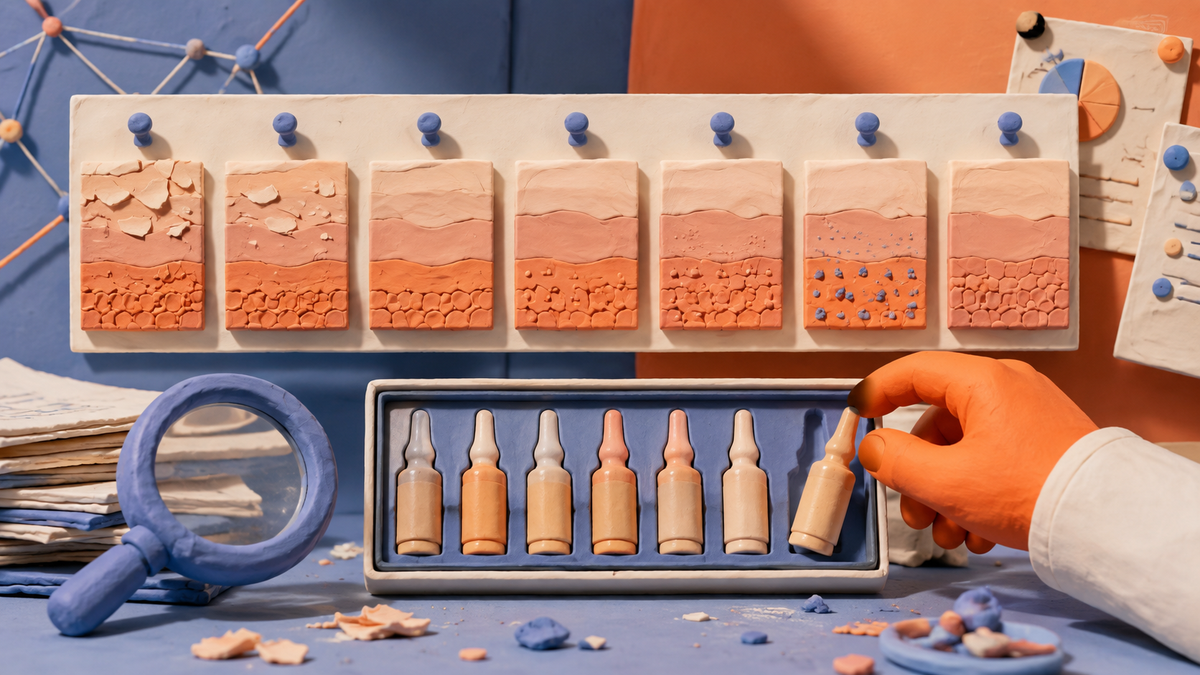
The box has seven ampoules in it and a number on the front. One a day, for a week.
We wanted to know where seven came from. Not rhetorically — we sell the thing, and if there is a study behind the schedule we would like to cite it.
We did not find one. We did not find a study behind any exfoliation schedule.
Every acid trial we could find fixes the frequency before it starts — twice weekly, nightly, one peel every fortnight — and then measures acne counts, pigmentation or wrinkle scores at the end. Frequency is an input to those studies, never the thing being compared. We searched for a trial that randomised people to different application frequencies of the same product at the same strength and compared the outcomes, and came back with agent-versus-agent comparisons instead. "Two to three times a week" is convention. It might be right. Nobody has checked.
What the acid literature actually tests
There is plenty of it, and it is decent work. A 2018 randomised controlled study compared a retinaldehyde cream against a course of glycolic acid peel sessions for anti-ageing. A comparative study set 30% salicylic acid peels against 50% glycolic acid peels in mild to moderate acne. Both are real trials with real endpoints.

Look at the structure of them. Agent A on a fixed schedule versus agent B on a fixed schedule. The schedules are chosen by the investigators from clinical practice, written into the protocol, and never varied.
So the literature can tell you that a salicylic peel outperforms or matches a glycolic peel at the intervals normally used. It cannot tell you whether those intervals are the right ones, because no arm of any of those studies was assigned a different one.
That is not a criticism of the trials. Adding a frequency dimension multiplies the arms and the cost, and the clinical question at the time was which acid, not how often.
How we searched, and what came back
We looked for randomised comparisons of application frequency for the same exfoliating agent at the same concentration. What the index returned was peel-versus-peel comparisons, cream-versus-peel comparisons, and a lot of consumer guides confidently stating a number with nothing under it.

We could easily have missed something. This is one desk with a search box, not a systematic review, and the phrasing that would surface a frequency-arm trial is not obvious. If it exists, we want it, and we will correct this article.
What we can say is that the number on the front of an exfoliant box is a product decision. Seven ampoules is a week of use and a natural retail unit. It is not a dose finding.
The recovery timescale nobody has measured for acids
There is one adjacent measurement worth having, and it is about detergents rather than acids.

Löffler and Happle patch-tested surfactants in Contact Dermatitis in 2003 and followed the skin afterwards. Sodium lauryl sulfate produced effects that were still measurable at day 10 from a single exposure. Sodium laureth sulfate was detectable up to day 7. An alkyl polyglucoside showed nothing significant even at day 3.
Ten days from one patch. That is the kind of number that would settle the frequency question if somebody produced the equivalent for a 5% glycolic acid or a 2% salicylic acid at cosmetic pH.
We could not find it. Which means the interval advice everyone gives — including us, in previous articles — rests on how skin looks and feels rather than on a recovery curve.
The regulator treats acids as worth flagging
Korean labelling rules let brands abbreviate the ingredient statement on small packages — anything from 10 to 50 millilitres or grams can carry a shortened list. A handful of ingredients cannot be dropped even then, and fruit acid, AHA, is one of them.
That is a small piece of regulatory signalling and worth reading correctly. It does not say acids are dangerous. It says the regulator considers their presence something a buyer should always be able to see, even on a package too small to carry a full list.
The corresponding schedule of use precautions sits in a separate annex of the enforcement rule, which we did not manage to open this week.
What our screening found
Our own kit scores 9.0, which puts it in the bottom quarter of this catalogue, and the reasons are on the label. Four of its forty-one rows carry a mid flag: salicylic acid, glycolic acid, tea tree leaf oil, and alcohol denat. The two acids are the product working and we would not want them gone. The other two are harder to defend. Denatured alcohol in an exfoliating formula is a solvent and an astringent that adds nothing to the acid chemistry, and tea tree oil — which the European committee has called a moderate sensitiser — is doing nothing about keratin at all. Take those two out and this is a 9.5 product. We would rather sell that version.

hidiff Royal Soft Clean Kit 10ml x 7ea
Glycolic and salicylic acid in seven daily ampoules. Also contains denatured alcohol and tea tree oil, both of which we flag and neither of which is doing exfoliating work. Seven consecutive days is the packaging, not a protocol.
The practical takeaway
In the absence of a frequency trial, the honest advice is to let the skin set the interval rather than the calendar. Stinging that lasts, tightness that does not settle, or a flush that is still there the next morning are signals to wait longer. None of that is a diagnosis and none of it needs a name.

Change one variable at a time. If you shorten the interval and something goes wrong, you know what caused it. If you shorten the interval and add a new serum in the same week, you have learned nothing and wasted a fortnight.
Watch for stacking rather than frequency. The failure we see most often is not using an acid too often, it is using three products that each contain one without noticing — salicylic acid alone is in ten of the products we sell.
And a seven-day kit is a seven-day kit because seven ampoules fit in a box. Use them on seven consecutive days if your skin is happy with that, and across three weeks if it is not. Nothing in the evidence base prefers either. The same question applies to cleansing twice, and order matters less than people think. Our method sits on the awards page.
- Löffler H, Happle R. "Profile of irritant patch testing with detergents: sodium lauryl sulfate, sodium laureth sulfate and alkyl polyglucoside." Contact Dermatitis, 2003. Readings at 24 h, day 7 and day 10. PMID 12641575.
- "Antiaging efficacy of a retinaldehyde-based cream compared with glycolic acid peel sessions: a randomized controlled study." 2018. PMID 30027612. Cited as an example of what does get randomised.
- "A comparative study of 30% salicylic acid peel and 50% glycolic acid peel in mild to moderate acne vulgaris." Indian Journal of Clinical and Experimental Dermatology, 2025.
- 「화장품법 시행규칙」 — ingredients that cannot be omitted from an abbreviated ingredient statement on 10–50 mL/g packaging, including 과일산(AHA). Read via 법제처 「찾기쉬운 생활법령정보」.
- 「화장품법 시행규칙」 [별표 3] 사용할 때의 주의사항 — annex not opened this week.
- DHALIORA screening data: 56 products, 1,920 ingredient rows, full recount 2026-09-06. hidiff kit, 41 rows, 4 flagged.