Korea Banned Plastic Microbeads in 2017. What Replaced Them in Our Catalogue Is Sugar, Sea Salt and Powdered Mung Bean.
We searched all 1,920 ingredient rows in our catalogue for a plastic scrub particle and did not find one.
That is the expected result, and it is worth saying out loud anyway, because it is the outcome of four separate pieces of law written on three continents inside about eight years. Korea moved in 2017. The United States had moved in 2015. England followed in 2017, and the European Union caught up in 2023 with a much broader restriction that covers a lot more than face scrubs.
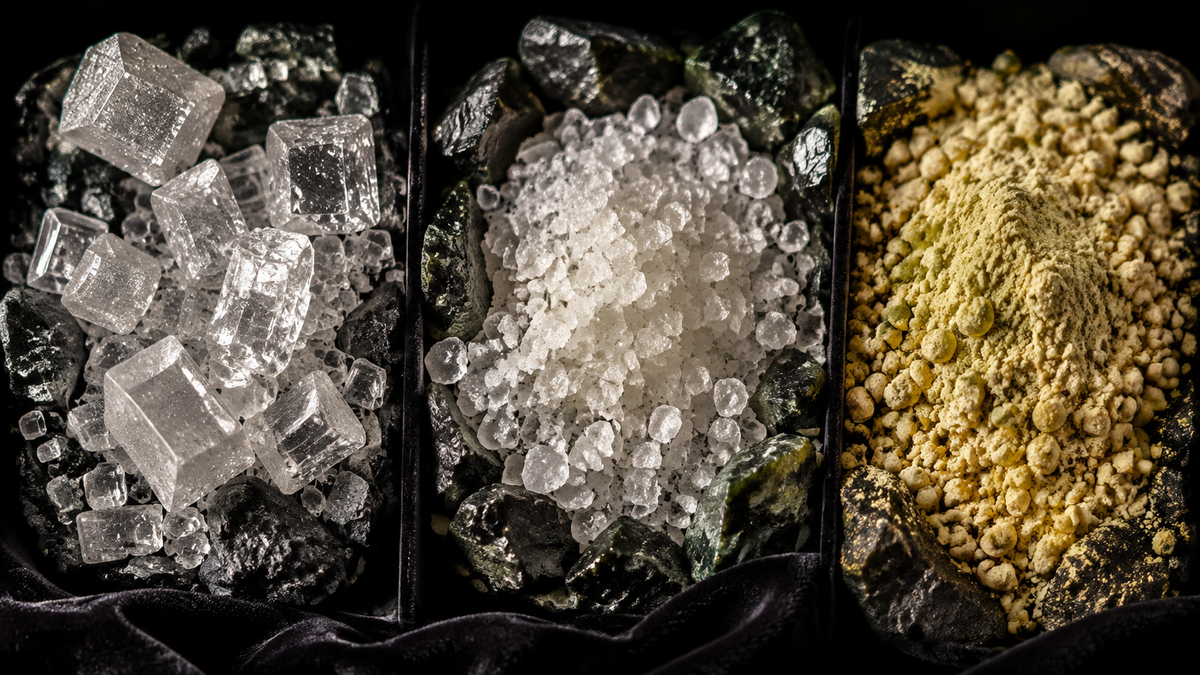
What we found instead was sugar, sea salt, mung bean powder, mint leaf powder and amber. Five products, five different particles, and not one line of regulation anywhere that says any of them has to be kind to your face.
Plastic microbeads are gone from rinse-off cosmetics in every major market we sell into, and gone from our catalogue — zero rows out of 1,920. The replacements are all mineral or botanical, and here is the part the bans never addressed: particle hardness, edge shape and size are not regulated anywhere. A ban on the material is not a standard for the abrasive. Two of our five particles dissolve while you use them, which limits how much damage they can do. Three do not.
What actually got banned, and where
Korea's Ministry of Food and Drug Safety added microplastics to the list of substances that may not be used in cosmetics, through an amendment to the Regulation on Safety Standards for Cosmetics, notice 2017-114. The United States got there first with the Microbead-Free Waters Act of 2015, which prohibited manufacturing and then sale of rinse-off cosmetics containing plastic microbeads on a staged timetable. England's microbead regulations followed in 2017.

The European Union's version is the odd one out and by far the largest. Commission Regulation (EU) 2023/2055, adopted on 25 September 2023, does not sit in cosmetics law at all — it added entry 78 to Annex XVII of REACH, the chemicals regulation, restricting synthetic polymer microparticles across products generally. The rinse-off cosmetics part started applying on 17 October 2023, with later deadlines for other categories running years out.
Four instruments, four legal homes, one substance class. Rinse-off cosmetics were the easy first target everywhere, because the beads were doing an obvious job that other materials could do.
We could not open the Korean annex itself this week — the government legal database would not serve the page — so we are citing notice 2017-114 by number rather than quoting the entry. The number is confirmed in the WTO trade-barrier notification that accompanied the amendment. We have not read the list.
What our five scrub particles actually are
Across 56 products, five carry an ingredient our data files as doing physical work on the surface.

| Product | Particle | Dissolves in use? |
|---|---|---|
| Beauty Recipe after-waxing scrub (9.5) | Sucrose | Yes |
| EIIO sea salt scalp scaler (9.0) | Sodium chloride, declared at 46% | Yes |
| papasoap blemish-care bar (9.0) | Mung bean seed powder | No |
| YBK foam cleanser (9.8) | Mentha arvensis leaf powder | No |
| SHINGMULNARA cleansing balm (9.8) | Amber powder | No |
The dissolving column is the one nobody prints. Sugar and salt are water-soluble, so the moment they meet a wet face they start becoming smaller and rounder, and by the end of a wash they are mostly gone. Their abrasive life is measured in seconds.
Mung bean powder, mint leaf powder and amber do not do that. Whatever shape they had when they went into the tub is the shape they have when they reach your skin, and the shape they have when they go down the drain.
Natural is not the same as gentle
The bans regulate what a particle is made of. They say nothing about how hard it is, how sharp its edges are, or how big it is.

That gap is not academic. The complaint that drove the microbead campaigns was environmental — tiny spheres passing through wastewater treatment into rivers — not dermatological. Polyethylene beads were, if anything, unusually well behaved against skin, because manufacturers could make them perfectly spherical and pick the diameter. A crushed shell or a ground seed is neither round nor uniform by nature, and nothing in Korean, American, British or European law asks it to be.
We would like to hand you a trial comparing skin damage from ground botanical particles against the plastic ones they replaced. We looked and did not find one that would settle it. So this is chemistry and geometry reasoning, not evidence, and we are labelling it as such.
Amber powder, in the cleansing balm, is the one that gives us most pause — fossilised resin, ground. It sits in an oil balm rather than a foaming scrub, which lowers the friction considerably, and our data files it under texture rather than exfoliation. We are not calling it a problem. We are saying nobody checked.
The one polyethylene line in our catalogue, and why it is not a microbead
Search our data for polyethylene and you get exactly one hit: the NEER'G sun stick. We want to be precise about it, because a search-and-shout would get this wrong.
It is there as a structuring agent. A sun stick has to stay a stick at 30°C and then melt onto skin under a thumb, and polyethylene wax is one of the materials that does that job. It is not a particle, it is not there to abrade anything, and it is not what any of the four regulations were written about.
The EU restriction is the one where this distinction gets genuinely difficult, because entry 78 covers synthetic polymer microparticles as a class rather than beads in scrubs, and it reaches film formers and other polymers on long timelines. Whether every polymer in a leave-on sunscreen sold into the EU stays compliant through the later deadlines is not a question we can answer from an ingredient list, and it is not a question we have asked our suppliers. It is on the list now.
What our screening found
Zero plastic microbeads across 56 products and 1,920 rows, which is the floor rather than an achievement — selling them would be illegal in three of our markets. The finding we did not expect is that our own database does not agree with itself about what these particles are for. Sea salt is filed as Physical Scrub, mung bean as Exfoliant, mint leaf powder and amber as Texture. Four strings for one job. We cannot currently answer "which of your products contain an abrasive" with a query, only by reading. That is the same controlled-vocabulary problem we found in our panthenol rows, and it is now the second week running that it has cost us an hour.
The practical takeaway
If you use a physical scrub, the useful question on the back of the pack is whether the particle dissolves. Sugar and salt shrink as you work; ground seeds, shells, powders and resins do not. That single property does more to bound the risk than the word "natural" on the front does.

Scalp is a different case from face. Our sea salt product is a scalp scaler at a declared 46% salt, used on skin under hair, and salt dissolving fast is most of why that concentration is workable. Do not read a scalp product's tolerance onto your face.
And the environmental win here was real, which is worth stating plainly in a piece that has spent four sections poking at the rules. Four jurisdictions removed a persistent plastic from a product category that flushes straight into water, and the replacements are food-grade sugar and salt. That is regulation working. It just was not written to make your scrub kinder, and it did not.
We have written about how little the word "clean" carries, and "natural particle" belongs in the same box. Our scoring method and its gaps are on the awards page, alongside the ingredients we flag most often.
- 「화장품 안전기준 등에 관한 규정」 식품의약품안전처 고시 제2017-114호 — microplastics added to the list of substances that may not be used in cosmetics. Annex text not opened; number confirmed via the accompanying WTO TBT notification.
- Microbead-Free Waters Act of 2015, Public Law 114-114 (United States).
- The Environmental Protection (Microbeads) (England) Regulations 2017.
- Commission Regulation (EU) 2023/2055 of 25 September 2023 amending Annex XVII to REACH as regards synthetic polymer microparticles. CELEX 32023R2055. Rinse-off cosmetics from 17 October 2023.
- DHALIORA screening data: 56 products, 1,920 ingredient rows, full recount 2026-09-06. Physical particles in 5 products; polyethylene in 1 row, as a structuring agent.