Clinic to Shelf: PDRN, Exosomes and Spicules Took the Same Road. Only One Arrives Intact.
Placentex is a prescription. It comes as a 0.08% cream for superficial wounds and minor skin ulcers, or as 5.625 mg in 3 mL to inject, and it has been used that way in Italian clinics for years.
We sell a 100 ml spray with the same active class printed on the front. The ingredient sits thirty-seventh on a list of forty-eight, at a concentration nobody will tell us, including our supplier.
That distance is what this piece is about. Not whether PDRN works, which we argued about in an earlier deep-dive, and not whether spicules work, which we argued about here. This is about the road three clinic ingredients took to get onto a shelf, and what fell off the truck.
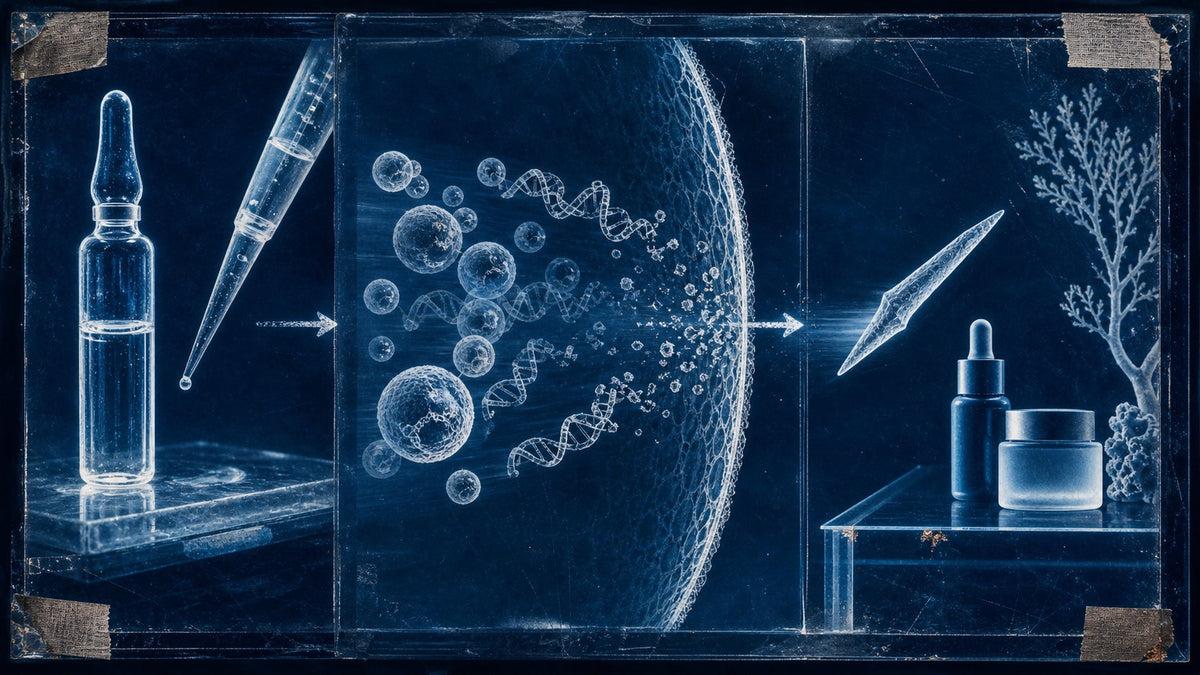
PDRN, exosomes and sponge spicules all crossed from clinics into consumer bottles inside about three years. Two of the three are far too large to enter intact skin at all, so what you buy is the name rather than the mechanism. The third, spicules, physically works, because it makes holes, and that is precisely why it is the one with a documented irritation trade-off. Our own two products here score 9.5 and 9.1, and neither number should be read as evidence that the headline ingredient is doing anything at the dose it is present in. We do not know that dose. Neither does anyone selling it to you.
The naming convention arrived after the shelf did
People in this industry like to quote an eighteen-month lag between a clinic treatment going viral and a drugstore version appearing. We went looking for a source for that number and could not find one, so we are not going to repeat it as though it were measured.
What we can date is the paperwork. In January 2025, a group led by Cíntia Marques published a paper in Biomolecules whose entire purpose was to propose a standard definition separating polydeoxyribonucleotides from polynucleotides, because the two words had been used interchangeably for years despite describing chains of very different lengths. They set the boundary at 1500 kDa and named it after the lead author.
Read that again with the dates in mind. A field agreed on what its flagship ingredient is in 2025, several years after that ingredient was already printed on the front of bottles in three countries.
The word ships first.
PDRN: a stated dose in the clinic, a blank on the shelf
A 2025 review in Applied Sciences by Park and colleagues lays out what PDRN is actually approved for, and the list is short: wound healing and dermal fillers. The registered formats carry numbers. A 0.08% cream. A 0.75 mg/3 mL topical solution. Injectables at 2.25 or 5.625 mg per 3 mL. An ophthalmic solution at 0.75 mg/mL.

The trial evidence behind those approvals is real and modest. The largest study the review cites enrolled 216 patients with diabetic ulcers and found 37.3% complete wound closure against 18.9% for placebo. The aesthetic work is smaller: 27 participants in one split-face trial, 218 subjects in a periorbital wrinkle study. The authors say plainly that these studies remain limited in scale and duration.
Now the size problem. Marques and colleagues put the traditional PDRN range at 50 to 1500 kDa, with some recent papers stretching it from 1 to 10,000 kDa. Bos and Meinardi's 2000 rule in Experimental Dermatology holds that compounds above roughly 500 daltons do not cross intact human skin, on the evidence that essentially no known contact allergen, topical drug or transdermal patch ingredient sits above that line.
Fifty kilodaltons is fifty thousand daltons, which is the small end of PDRN and a hundred times over the bar.
Notice which topical format actually got approved. A 0.08% cream for superficial wounds and minor skin ulcers — broken skin. The one regulator-sanctioned topical use of PDRN is on skin where the barrier is already open, which is the whole argument in one line. The proposed mechanism, adenosine A2A receptor activation plus a nucleotide salvage pathway, requires the fragments to reach fibroblasts in the dermis. On intact skin they do not get there.
And ours is not even salmon
Our own PDRN product lists its hero ingredient as Sodium DNA, described as vegan white lotus PDRN. Every clinical paper we read used DNA extracted from salmon or trout.
We looked for a trial of plant-derived Sodium DNA in skin. We did not find a negative one. We found none at all.
There is a second sleight of hand in the name, and it is ours to own because we stock the thing. Nelumbo nucifera flower extract is a separate ingredient, sixteenth on the list, graded low, doing a soothing job. The Sodium DNA is thirty-seventh. The product name welds a botanical near the top of the list to a clinic acronym near the bottom, and the two are not the same ingredient.
Ten of the forty-eight entries are hyaluronic acid wearing different names. One is the thing on the front of the bottle.
Exosomes: the one nobody approved
On 6 December 2019 the FDA issued a public safety notification with a sentence that has not changed since: "There are currently no FDA-approved exosome products." Exosomes used to treat conditions in humans are regulated as drugs and biological products. The notification followed reports of serious adverse events in patients in Nebraska treated with unapproved exosome products. The agency's consumer alert, last updated 9 April 2024, says the same thing again.

Meanwhile there are exosome serums in every K-beauty haul on the internet.
We should be careful about the comparison, because a cosmetic exosome serum is not the clinic injection the FDA was warning about, and pretending otherwise would be exactly the move we are complaining about. The narrower point stands. A word crossed from biologics into cosmetics carrying its clinical glow and none of its clinical status, and the agency's own position on that word is that nothing bearing it has been approved for anything.
We do not sell one. None of our fifty-four products lists an exosome-type ingredient.
We would rather not dress that up as principle. Nobody has put one in front of us that we could grade.
Spicules: the one that arrives intact, which is the worry
Spicules are different in kind, and the difference is that they do not need to dissolve into anything. They are silica needles from freshwater sponge, and they work by making holes.
The most useful measurements we found come from a 2019 paper in Biological and Pharmaceutical Bulletin by Tansathien and colleagues, who were building a spicule cream as a delivery system and therefore had to measure the needles. Unprocessed sponge microspicules came in at 11.89 µm wide and 176.77 µm long. The stratum corneum is roughly 10 to 20 µm thick.
So the needle runs about ten times longer than the 10-to-20 µm barrier it is crossing.
Their comparison is the honest part. Long spicules enhanced protein permeation 2.26-fold over a plain solution and caused significant irritation. Blended-short spicules, around 85 µm, enhanced permeation 1.94-fold and did not. After fourteen days the short-spicule cream reduced melanin and erythema while improving elasticity and hydration.
Longer needle, more delivery, more irritation. That trade-off is legible, quantified and published, which is more than either of the other two ingredients can say — and it came from a pharmacy lab in 2019, not from a brand.

What our screening found

Our spicule ampoule screens 9.1. The best Amazon rival in its benchmark set is SKIN1004's Hyalu-Cica Blue Serum at 9.2, and that product contains no spicules at all, so in our own comparison we lose to the thing that does the opposite. It is also the product where our two internal score fields disagree most: 9.1 in one, 7 in the other, the widest gap in the catalog. Hydrolyzed Sponge is eleventh of eighty-seven ingredients and is one of only six we graded mid, alongside retinol and lavender oil, plus three declared fragrance allergens. Our PDRN spray screens 9.5 and ties its nearest rival, Anua's PDRN serum, at 9.5. Read all of these numbers with the caveat we published in our benchmark audit: we score rivals off six-ingredient summary decks and ourselves off full lists, so the comparison flatters us by construction.
reslow White Lotus PDRN Spray Serum 100ml
Forty-seven of forty-eight ingredients screen low risk, and it is a genuinely good multi-weight hyaluronic mist. Buy it for that. The Sodium DNA sits thirty-seventh, it is plant-derived rather than the salmon material in the trials, and it also carries added fragrance.
Sunday To Monday Diamond Spicule 5000 Shot
Our lowest-agreement product: 9.1 on one field, 7 on another. It contains retinol and three fragrance allergens on top of the spicules, and the Tansathien data says longer needles buy delivery with irritation. Weekly treatment, not a nightly serum, and not for reactive skin.
The practical takeaway
Find the clinic ingredient on the back of the bottle before you believe the front. Position is not concentration, but an active sitting below the preservatives is present in trace amounts, and thirty-seventh of forty-eight tells you something the word PDRN does not.

Then ask which form was studied. Salmon DNA injected into a dermis at 5.625 mg is not plant Sodium DNA sprayed onto intact skin, and the literature attached to the first does not transfer to the second by sharing a name.
Spicules deserve separate treatment because they are the one that physically does something. Use them the way you would use an exfoliating acid: occasionally, on skin that tolerates it, never on the same night as a retinoid, and never on a face that is already angry.
And if a category has no approved product anywhere, the way exosomes currently do not, that is worth knowing before the price tag persuades you otherwise. We publish scores for everything we stock, and none of those scores is a measure of whether the headline molecule reached your dermis.
- C. Marques, A. Porcello, M. Cerrano, et al., "From Polydeoxyribonucleotides (PDRNs) to Polynucleotides (PNs): Bridging the Gap Between Scientific Definitions, Molecular Insights, and Clinical Applications of Multifunctional Biomolecules," Biomolecules 15(1): 148 (2025). link
- S. Park, S. Baek, H.-J. Shin, et al., "Polydeoxyribonucleotides as Emerging Therapeutics for Skin Diseases: Clinical Applications, Pharmacological Effects, Molecular Mechanisms, and Potential Modes of Action," Applied Sciences 15(19): 10437 (2025). link
- J. D. Bos, M. M. H. M. Meinardi, "The 500 Dalton rule for the skin penetration of chemical compounds and drugs," Experimental Dermatology 9(3): 165–169 (2000). link
- U.S. Food and Drug Administration, "Public Safety Notification on Exosome Products," 6 December 2019. link
- U.S. Food and Drug Administration, "Consumer Alert on Regenerative Medicine Products Including Stem Cells and Exosomes," updated 9 April 2024. link
- K. Tansathien, P. Suriyaaumporn, P. Charoenputtakhun, T. Ngawhirunpat, P. Opanasopit, W. Rangsimawong, "Development of Sponge Microspicule Cream as a Transdermal Delivery System for Protein and Growth Factors from Deer Antler Velvet Extract," Biological and Pharmaceutical Bulletin 42(7): 1207–1215 (2019). link