We Sell a Gel Called 'Aloe CICA'. There Is No Centella in It.
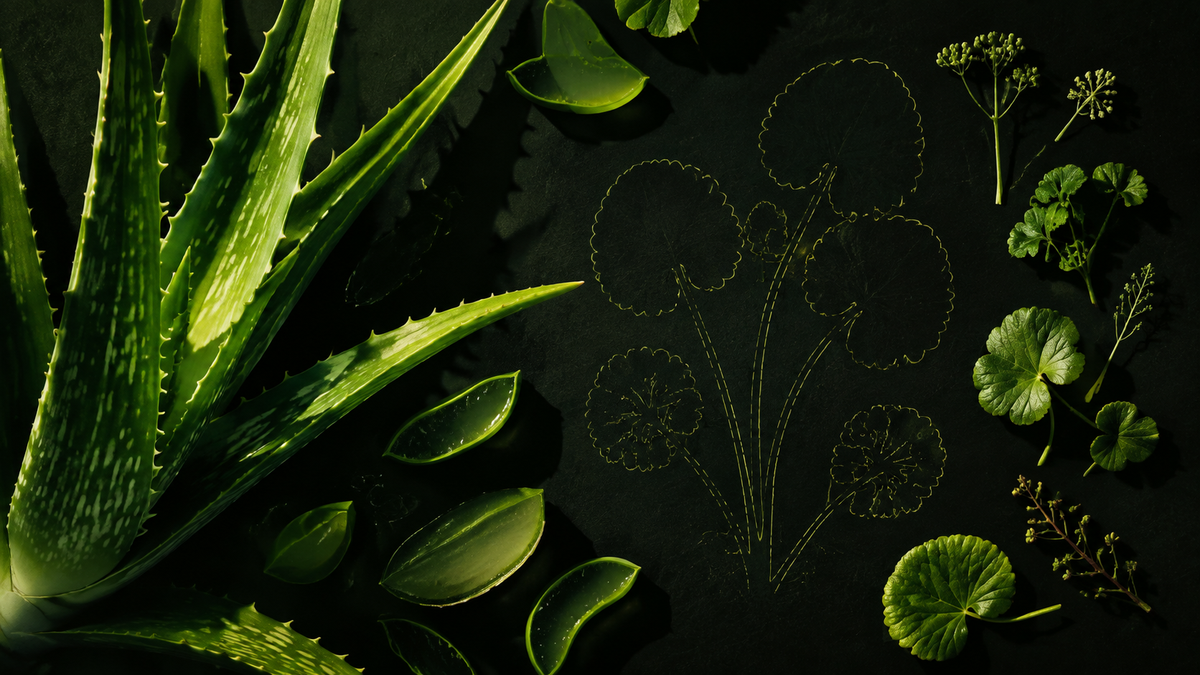
There is a gel in our catalogue called CUREα Aloe CICA Soothing Gel. We read all 30 ingredients on the back of it, one line at a time. Centella asiatica is not among them. Neither is madecassoside, asiaticoside nor asiatic acid, the purified molecules the word "cica" was clipped out of in the first place.
Ingredient 1 is Aloe Barbadensis Leaf Juice. Ingredient 4 is ethanol, which our screening grades mid risk and files under "Alcohol / Astringent". The gel scored 8.8 out of 10 and it is a decent aloe gel. It is not a cica product, and the word is on the front of the tube.
On 16 August 2026 we added a disclosure paragraph to that product page saying we had read all 30 ingredients and found no Centella. We did not change the product name. The name is the manufacturer's, printed on the tube, and it is not ours to rewrite.
We sell a gel named after an ingredient it does not contain, and the only fix available to us was a disclosure paragraph rather than a new name. Reading the science behind the word makes it more than a marketing quibble. The Centella research people cite is mostly run on TECA and ECa 233, purified fractions that the European Medicines Agency's herbal committee refused to classify as herbal preparations at all, on the grounds that the purification steps are "extreme". Crude Centella Asiatica Extract is a different material, and its triterpene-saponin content ranges from 1 to 8 weight percent depending on where the plant grew. Fifteen of our 54 products contain something Centella-related: 9 with the purified actives, 6 with only the crude extract, and two of those six name Centella as their hero ingredient anyway. Under EU Regulation 655/2013 a product name is legally a claim, and a claimed ingredient has to be deliberately present. Korea has no equivalent rule aimed at names, only a general catch-all against misleading labelling. And we cannot tell you, from any of those 15 labels, what concentration or standardisation is inside.
Our own label, and what we did about it
The odd part is that our own copy never made the claim. The hero-ingredient field in our data for that gel reads "Aloe Barbadensis Leaf Juice". The free-of chips read "Silicone-free · Paraben-free · Mineral-oil-free · Colorant-free", and none of them mentions cica. Every word we wrote about the product is about aloe. The only place the word appears is in the name we did not choose.

Which is exactly the position a lot of retailers are in, and it is not much of a defence.
A shopper searching for a cica gel lands on that page. The name is the first thing they read, and the ingredient list is the last, if they reach it at all. Whether the manufacturer or the retailer put the word there is an argument about who is responsible, not about whether the shopper got what they thought they were getting. So we wrote the disclosure and left the name alone. We would rather be visibly stuck than quietly benefiting. If the manufacturer reformulates or renames the gel we will say so on the same page, and if they do neither, that paragraph stays there permanently.
One thing to be clear about before going further. "Cica" is not a legally defined or regulated term anywhere we could find, not in the EU and not in Korea. It is marketing shorthand that drifted from the name of a plant into a general signal for "soothing". A brand cannot be prosecuted for using it, in the same way nobody gets prosecuted for the word "glow".
Centella, after somebody purifies it
Most of the Centella research that gets cited is not research on Centella extract. It is research on TECA, the titrated extract, which the EMA's herbal committee describes as a 70% ethanolic extract carrying asiaticoside at 40% and triterpenic genins at 60%, those genins being roughly 29-30% asiatic acid, 29-30% madecassic acid and about 1% madasiatic acid.

That committee then declined to call it a herbal preparation.
Their reasoning is unusually blunt for a regulatory document. The purification steps are "extreme and involve chemical treatments that remove the herbal matrix", and "the natural proportion of the components is not maintained". The most-studied Centella material in existence is, on its own regulator's reading, a manufactured mixture of four triterpenes that happen to have come from a plant.
The other standardised material in the literature is ECa 233, which Tan and colleagues put at 51% madecassoside and 38% asiaticoside in their 2021 review. That same review makes a point which reframes the whole ingredient: asiaticoside appears to act largely through in vivo conversion to asiatic acid. So a label naming one of them is not clearly telling you which molecule does the work.
Set that against what "Centella Asiatica Extract" means on an INCI list. A 2024 paper on cold-processed topical formulations reports that the triterpene-saponin content of the crude plant runs from 1 weight percent to 8, depending on where the plant was grown. That range exists before anybody dilutes the extract into a cream.
Eight-fold.
Two of our own products name Centella Asiatica Extract as their hero ingredient with no purified active anywhere in the formula: a papasoap blemish-care bar and a Beauty Recipe cleansing water. Both are honest about containing the plant. Neither one can tell you which end of that 1-to-8 range arrived in the batch.
Six clinical studies, and one of them found nothing
A 2024 review in Pharmaceutics gathered the clinical work on topical Centella in wound healing and found six studies to review. Six. That is the clinical base underneath the most-hyped soothing ingredient in Korean skincare.

What is inside it does not point one way. A split-face randomised trial by Damkerngsuntorn used a 0.05% ECa 233 gel after laser treatment and saw erythema resolve by day 7 against day 28 for placebo, which is a real result on a measurable endpoint. A trial by Kuo, 24 patients with 12 per arm, found no significant difference against a plain hydrocolloid dressing. The review's authors then add the detail that matters most to anyone holding a cosmetic label: in most of the trials the formulation was "not further specified" for standardisation.
Then there is the batik study.
Anggraeni and colleagues ran a double-blind trial in 2021 on 30 Indonesian batik workers over four weeks, measuring barrier function on hands that spend the working day in wax and dye. The Centella cream improved hydration, palmar p=0.007 and dorsum p=0.001. It also showed no significant difference against the ceramide cream it was tested against. Which is a genuinely useful finding, and not the one that reaches packaging: Centella worked, and so did a cheaper and far better-characterised comparator.
None of that makes Centella a bad ingredient. It makes it a modestly evidenced one. Small trials, short durations, undisclosed standardisation, and at least one head-to-head that ended level.
And before anyone takes comfort in the aloe that actually is in our gel, the aloe evidence is not better. The Centre for Reviews and Dissemination at the University of York ran a systematic review of aloe vera's clinical effectiveness in 1999 and found contradictory results across 10 trials. In one wound study aloe healed 72 hours faster. In another it took 30 days longer. Their conclusion was that effectiveness "is not sufficiently defined at present", and nothing we have found since replaces that with something clean.
So the honest description of our gel is a plant with weak evidence, sold under the name of a plant that is not in it.
In Brussels a name is a claim. In Seoul it is a catch-all.
Commission Regulation (EU) No 655/2013 sets the common criteria for cosmetic claims, and Article 1 defines the scope in a way that closes the obvious loophole. The Regulation applies to claims "in the form of texts, names, trade marks, pictures and figurative or other signs". Names are in the list.
Criterion 2, truthfulness, then says it outright: "If it is claimed on the product that it contains a specific ingredient, the ingredient shall be deliberately present." The six criteria run in a fixed order, legal compliance first, then truthfulness, evidential support, honesty, fairness and informed decision-making. Truthfulness sits second, ahead of any question about evidence.
Read those two lines together and a gel called Aloe CICA containing no Centella fails on the Regulation's plain wording. Not on a judgement call about how consumers perceive a word. On the text.
Korea is where this gets less tidy.
The relevant instrument is 별표 5 of the 화장품법 시행규칙, the schedule covering the scope and observance rules for cosmetic labelling and advertising, as amended on 12 December 2019. Clause 나 does regulate product names, but only against a specific harm: a name falsely implying 기능성, 천연 or 유기농 status. Centella is not one of those categories. Clause 사 is the general catch-all, covering labelling that is false or exaggerated, or "partially true but overall likely to mislead consumers".
There is no Korean clause written for a product name implying an ingredient the product does not contain. We went looking for one. A regulator who wanted to could plausibly reach our gel through the catch-all, and as far as we can tell nobody has tried. The EU is the jurisdiction with the clean hook here, and saying otherwise would be exactly the sort of tidy story this article is about.
None of this is a legal opinion. Regulation 655/2013 governs products placed on the EU market, not a gel manufactured and sold in Korea. We use the EU text because it is the clearest written statement anywhere that a name counts as a claim.
What our screening found
The worst finding in this article is our own product. CUREα Aloe CICA Soothing Gel: 30 ingredients, zero Centella entries of any kind, ethanol fourth on the list at mid risk, and a disclosure paragraph we only added on 16 August 2026, after we counted. Across the catalogue, 15 of our 54 products contain something Centella-related, and the split is the interesting part: 9 carry the purified actives (madecassoside, asiaticoside or asiatic acid) and 6 carry only crude Centella Asiatica Extract. Two of those six name it as their hero ingredient regardless. And we cannot tell you, from any of the 15 labels, what concentration is in the jar or whether the material was standardised at all, because INCI lists carry no percentages and none of these brands publish them. That is the same hole we hit when we went looking for niacinamide percentages. One more flag on the cleanser below: its free-of chips read "No added fragrance", a softer phrasing we apply inconsistently against the stricter "Fragrance-free" elsewhere in the catalogue, which we wrote about earlier this year and still have not fixed.

The name says CICA and none of its 30 ingredients is Centella, which is why this article exists, and ethanol sits fourth on the list, so it is a poor pick for reactive skin. Underneath the name it is an aloe gel with Aloe Barbadensis Leaf Juice first, silicone-free and colorant-free, and competent at that job.

YBK Relief Hydration Light Foam Cleanser
Its free-of chips say "No added fragrance" rather than fragrance-free, which is our own inconsistent phrasing, and at 51 ingredients it is a long list to read before you buy. It does contain the purified Centella actives that its "Cica plus 5-Ceramide Complex" hero claim implies, which is more than the gel above can say for itself.
The practical takeaway
Buy on the ingredient list, not on the front of the box. If a product name contains cica and the INCI list contains no Centella entry, the name is decoration. That check takes about 20 seconds, and it is the check we should have run on our own gel before we listed it.

If you want the material the trials actually used, look for madecassoside or asiaticoside named individually rather than a bare "Centella Asiatica Extract", because the clinical work ran on TECA and ECa 233 rather than on crude plant. This is not a guarantee of dose. Nobody publishes the dose. It only narrows the range you are gambling on.
And keep the expectation the size of the evidence. Six clinical studies in the 2024 review, one finding no difference against a hydrocolloid dressing, one finding no difference against ceramides. Centella is a reasonable soothing ingredient with modest support behind it, not a treatment, and skin that stays irritated for more than a couple of weeks belongs in front of a clinician rather than in front of another jar.
As for us, the disclosure stays on the Aloe CICA product page until either the formula or the name changes. Our screening criteria already read every ingredient list end to end, and this is the first time that process caught the product name instead of the formula. There are 53 other names in our catalogue we have not checked against their labels, and we will publish what that turns up. Reading the label rather than the front of the box is the entire position we take on label claims.
- European Medicines Agency, Committee on Herbal Medicinal Products, "Assessment report on Centella asiatica (L.) Urban, herba" (superseded), EMA/HMPC. link
- Tan SC, Bhattamisra SK, Chan KG, et al., "Actions and Therapeutic Potential of Madecassoside and Other Major Constituents of Centella asiatica: A Review," Applied Sciences 11(18):8475 (2021). link
- Witkowska K, Paczkowska-Walendowska M, Plech T, et al., "Topical Application of Centella asiatica in Wound Healing," Pharmaceutics 16(10):1252 (2024). link
- Anggraeni S, Umborowati MA, Damayanti, et al., "Role of Centella asiatica and ceramide in skin barrier improvement: a double blind clinical trial of Indonesian batik workers," Journal of Basic and Clinical Physiology and Pharmacology 32(4):589-593 (2021). link
- Vinjamuri G, et al., "Controlled Release of Madecassoside and Asiaticoside of Centella asiatica L. Origin from Sustainable Cold-Processed Topical Formulations" (2024). link
- European Commission, "Commission Regulation (EU) No 655/2013 laying down common criteria for the justification of claims used in relation to cosmetic products," Official Journal of the European Union (2013). link
- 화장품법 시행규칙 [별표 5] 화장품 표시·광고의 범위 및 준수사항, 국가법령정보센터 (amended 2019.12.12). link
- Centre for Reviews and Dissemination, University of York, "Aloe vera: a systematic review of its clinical effectiveness," Database of Abstracts of Reviews of Effects (DARE) (1999). link