'Weakly Acidic' Is on Three of Our Labels. None of Them Prints a Number.
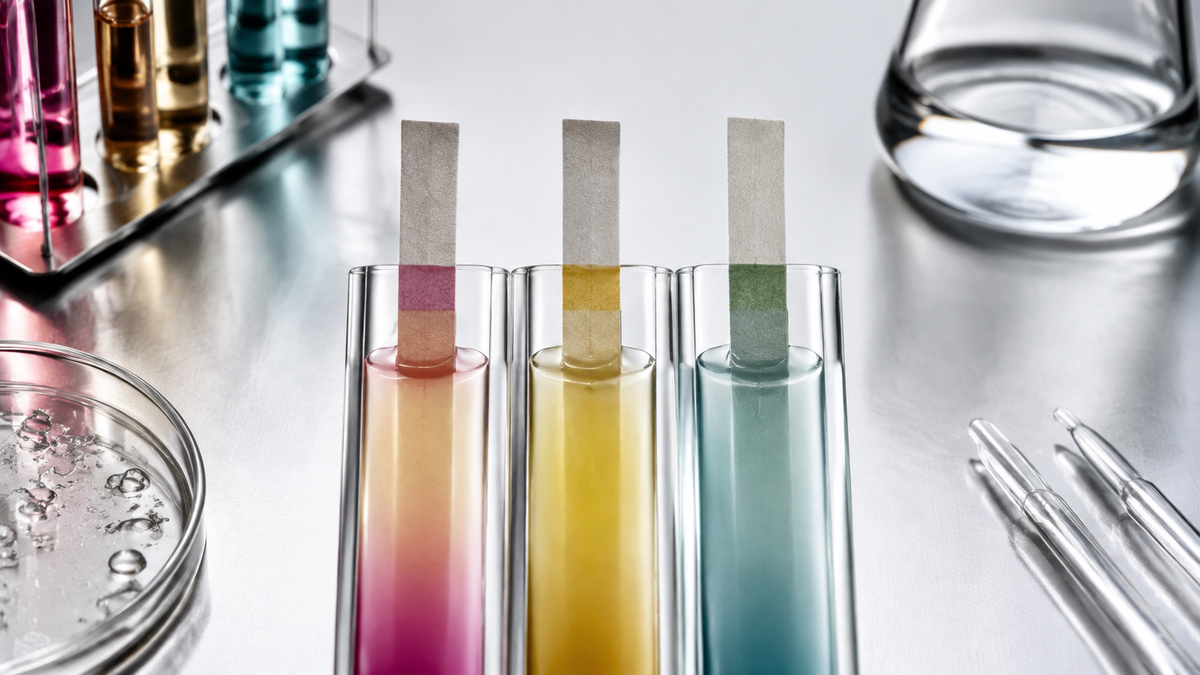
Three of our products tell you they are weakly acidic. A feminine wash, a scalp shampoo, a foam cleanser. All three of them say it in the label information we publish, and all three of them say it slightly differently.
None of the three gives you a number.
We went looking for one, in the ingredient data we hold and then in what the law actually requires. It isn't there, and after a morning on it we understand why. What we did not expect was how little our own database could tell us about a claim we repeat on our own shop.
Korean cosmetics law does not require a pH figure on a label, and the functional-cosmetics review rules exclude pH from the standards they set. So "weakly acidic" is a marketing phrase with no printed value behind it. It is still a claim, and under the substantiation rule the ministry can ask a company to prove it. Meanwhile, in our own catalogue, twenty-nine of fifty-six products log a pH adjuster or buffer in their ingredient list, and of the three products that actually say "weakly acidic," only one of them does. We cannot check the other two against anything.
What "weakly acidic" is pointing at
The idea underneath the phrase is real, and it comes from a specific measurement. Lambers and colleagues took skin surface pH readings from 330 people and reported an average of 5.12 with a standard deviation of 0.56 before washing, and 4.93 with a standard deviation of 0.45 twenty-four hours after washing with water alone.

The figure you usually see quoted from that paper is 4.7. It is worth knowing that 4.7 is the authors' extrapolation for skin left entirely alone, not a number anybody measured on a face. We have quoted it loosely ourselves in the past and will stop.
Either way, the direction is clear: healthy skin surface sits acidic, and a cleanser built at pH 9 or 10 will push it away from there for a while. That is a good reason to prefer a lower-pH cleanser. It is not a reason to accept an unquantified word as evidence you got one.
Three labels, three phrasings
Here is exactly what our three say.

| Product | The phrase, verbatim | Our score |
|---|---|---|
| cleety lacto probiotics foaming wash | Weakly acidic (pH-balanced) |
9.5 |
| againme BB scalp clear shampoo | Weakly acidic |
8.9 |
| ybk relief hydration light foam cleanser | Weakly acidic (low-pH) |
9.8 |
"pH-balanced" and "low-pH" are not the same claim. Balanced implies a target, matched to something. Low implies a direction and no target at all. And the bare version implies whichever one you happened to assume when you read it.
We did not write those strings. We transcribed them from the products. But we chose to publish them in a field called free-of, next to sulfate-free and paraben-free, which frames a formulation choice as an absence of something bad, and that framing is ours to answer for.
Korean law never asks for the number. It can still make you prove it.
The mandatory label items for cosmetics sold in Korea are set out in Article 10(1) of the Cosmetics Act. It is a long list. Product name, business name and address, price, manufacturing number, use-by date, the full ingredient list, capacity or weight, warnings. There is no pH on it.

The more interesting exclusion is one layer down. When the enforcement rules set out what a functional cosmetic's review documents have to cover, the standards clause carries a parenthesis excluding pH explicitly: standards, with the standard for acidity (pH) excluded. It is not an accidental gap. Somebody wrote pH out of the requirement on purpose.
Which means a product can say weakly acidic on its box in Korea, print no figure, and be entirely in order.
The other half of the picture is Article 14 of the same Act, the substantiation rule for labelling and advertising, and the ministry notification that fleshes it out. The structure is the reverse of what people assume. Nobody checks your claim before you print it. If the ministry asks, you have to produce evidence for it, and the burden sits with you.
So there are two honest sentences here and it matters which one you say. Not this: "if a product says weakly acidic it must print a pH." That is false and we have seen it written. This instead: a company that prints weakly acidic should be able to hand over a measurement on request, and you as a shopper have no way of knowing whether they can.
We looked for enforcement examples, cases where a pH claim was actually challenged and evidence demanded. We did not find any we could confirm. That is not evidence the rule is unused, only that we could not verify it either way, and it is the second thing today we could not close out.
What our own data can and cannot check
This is the part that turned the piece around on us.
Twenty-nine of our fifty-six products list at least one pH adjuster or buffer in their ingredient data. Eleven different substances do that job across the catalogue: citric acid, sodium citrate, tromethamine, arginine, sodium hydroxide, potassium hydroxide, succinic acid, sodium phosphate, disodium phosphate, sodium acetate, phosphoric acid.
Now put the three claimants against that list. The cleety wash logs citric acid and sodium citrate, which is a recognisable acid-plus-salt buffer pair and is at least consistent with a controlled slightly acidic pH. The ybk foam cleanser logs neither, nor anything else that adjusts pH. Neither does the againme shampoo.
That absence is not proof of anything. A cleanser built on sodium cocoyl glycinate and sodium lauroyl glutamate, which is what the ybk foam is, tends to land mildly acidic on its own without an acid being added, because those amino-acid surfactants behave that way. Plausible is the right word. Measured is not, and we have never asked either supplier for a reading.
The other thing that fell out of the count is a problem we keep finding in our own columns. Tromethamine appears in eight of our products graded low with the function "pH Adjuster," and once, in the celimax brightening pad, graded mid with the function "Buffer." Same molecule. The grade followed the label we typed next to it. Sodium citrate splits the same way, called a pH adjuster in four products and a buffer in six, though at least there the grade stays put.
What our screening found
Take the againme shampoo first, because it is the weakest of the three. It scores 8.9, and we flag a high on its Fragrance (Parfum) row plus a mid on menthol and a mid on its salicylic acid. It also carries the barest version of the claim, "weakly acidic" with no qualifier, and logs no pH-adjusting ingredient we can point at. The ybk foam at 9.8 is our highest-scoring cleanser and it is in the same position on this one point: fifty-one ingredient rows, every one graded low, and nothing in them that lets us check the label. Only cleety has an acid-buffer pair on the list, and it also carries a mid-graded tea tree oil we have written about separately. Our verdict on all three is the same and it is about us: we published a pH claim in a field meant for absences, and we hold no number behind any of it.

YBK Relief Hydration Light Foam Cleanser
Fifty-one ingredients, all graded low, on an amino-acid surfactant base. We still cannot verify the low-pH claim printed on it.

Cleety Lacto Probiotics Rejuvenating Foaming Wash
Carries a mid-graded tea tree oil. It is also the only one of the three with a buffer pair in its ingredient list.
What to do with this at the sink
Read the surfactants instead of the adjective. That is the whole practical trick, and it works because surfactant chemistry constrains pH in a way marketing copy does not. Soap-type names, the sodium laurate and sodium stearate family, mean a saponified bar or foam that has to run alkaline to exist at all. Amino-acid names, the glycinates and glutamates and isethionates, work in a mildly acidic range and are usually built there.

If a product says weakly acidic and its ingredient list is a soap base, those two things are fighting and the ingredient list wins.
The other move is to ask. A brand that measured its pH can tell you the number in one line, and one that never measured will say something else. We are going to start asking on our own catalogue, alongside the concentration questions we already owe our suppliers, and we will publish what comes back including the silences. If you want the method behind the scores in this piece, our screening approach is written out in full. Our companion pieces are the one on which label claims carry a legal definition, the audit of salicylic acid across ten of our products, and our argument about who actually needs to double cleanse, which is where cleanser pH matters most.
- Lambers H, Piessens S, Bloem A, Pronk H, Finkel P. "Natural skin surface pH is on average below 5, which is beneficial for its resident flora." International Journal of Cosmetic Science 2006;28(5):359–70. PMID 18489300. N=330.
- Republic of Korea, Cosmetics Act (화장품법), Article 10(1) — mandatory labelling particulars.
- Republic of Korea, Enforcement Rule of the Cosmetics Act (화장품법 시행규칙), Article 19(4)8 — review standards, with the standard for acidity (pH) expressly excluded.
- Republic of Korea, Cosmetics Act, Article 14 — substantiation of labelling and advertising.
- Ministry of Food and Drug Safety Notification No. 2020-80, Regulation on the Substantiation of Cosmetic Labelling and Advertising.
- DHALIORA ingredient database, full recount of all 56 products' ingredient lists, 3 September 2026.
Source links are omitted from this piece pending re-verification; each reference above is cited by its official identifier so it can be looked up directly.